

How Your Skin Is Assessed Before DPL in Macquarie Park

A considered DPL treatment process begins well before the first pulse of light. How Is Your Skin Assessed Before DPL Treatment in Macquarie Park? Through a considered consultation that looks beyond a single concern to understand your skin’s tone, sensitivity, history, and goals. This assessment helps the practitioner determine whether DPL is appropriate and how the treatment may be tailored to your individual skin characteristics
DPL, or Dynamic Pulsed Light, may be considered for concerns such as visible redness, uneven tone, sun-related pigmentation, and certain signs of photoaging. Suitability and outcomes vary between individuals. However, the right approach depends on the skin in front of your practitioner on the day, not simply the concern you see in the mirror.
Your DPL Consultation Starts With Your Skin Goals
Your appointment begins with a conversation about what you would like to improve. You may be concerned by persistent redness around the nose and cheeks, brown spots that have become more visible after summer, a dull complexion, or a combination of these concerns. Your practitioner will ask when the concern began, whether it changes with heat, stress, hormones, or sun exposure, and which outcomes matter most to you.
This discussion shapes the treatment plan. For example, diffuse redness and isolated pigment spots may require different treatment approaches and settings when light-based technology is considered. If your primary concern is melasma, active acne, significant texture, or laxity, DPL may be part of a wider plan, or another treatment may be more suitable. A thorough consultation includes determining whether treatment is appropriate and whether an alternative approach or further medical assessment may be required.
How Your Skin Is Assessed Before DPL Treatment in Macquarie Park
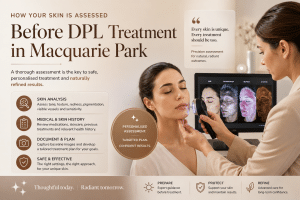
The clinical assessment considers your natural skin tone, current skin condition, and how your skin is likely to respond to light energy. A practitioner will look at the distribution, depth, and color of pigmentation, as well as visible capillaries, flushing, inflammation, dryness, and sensitivity. They will also assess whether a mark is likely to be pigment, a vascular concern, or something that should be reviewed by a medical professional before cosmetic treatment.
Your Fitzpatrick skin type may be recorded as part of this process. This classification helps estimate how readily skin burns, tans, or develops post-inflammatory pigmentation. It is a useful guide, but it is not the only factor. Recent sun exposure, a current tan, self-tanning products, and your individual history of pigmentation all influence whether treatment can proceed and how conservatively settings should be selected.
Close assessment also identifies areas that may need different treatment parameters. The cheeks, nose, forehead, and jawline do not always present the same level of redness, pigment, or sensitivity. Different areas may require different treatment parameters depending on the skin characteristics and concerns identified during assessment.
Your Medical and Skincare History Matters
DPL is not assessed in isolation from the rest of your routine. Your practitioner will review medications, supplements, skincare actives, and previous aesthetic treatments. Certain prescriptions and photosensitizing products can increase skin sensitivity. Retinoids, exfoliating acids, recent peels, laser treatments, and some injectables may affect timing or aftercare recommendations.
You may also be asked about a history of cold sores, keloid scarring, eczema, dermatitis, autoimmune conditions, hormonal pigmentation, or delayed healing. Pregnancy and breastfeeding should be discussed as well, as treatment timing may need to be adjusted. These questions are not a formality. They help the practitioner assess treatment suitability, potential risks, and whether any precautions may be required.
Examining Your Skin on the Day
Your skin should be assessed in its current state, ideally without makeup, so the practitioner can see its true tone and texture. Active irritation, sunburn, broken skin, or a recent tan can make DPL treatment unsuitable that day. In some cases, postponing treatment is the most refined and responsible choice.
Standardized photographs may be taken to document your starting point and monitor changes over time. This is especially valuable for pigmentation and redness, which can shift subtly over a course of treatments. Clear images provide an objective reference that can assist the practitioner in reviewing your skin’s response over time.
Selecting Settings and Considering a Patch Test
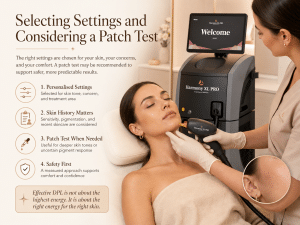
Once your assessment is complete, the practitioner selects settings based on the concern being treated, your skin characteristics, and the treatment area. DPL treatment does not necessarily involve using the highest possible energy. Settings are selected based on the treatment area, skin characteristics, treatment goals, and relevant safety considerations.
A patch test may be recommended, particularly for clients with deeper skin tones, a history of sensitivity, uncertain pigment behavior, or a recent change in skincare or health. The skin is then observed for an appropriate response before a full treatment is performed. This measured approach may add time to the treatment process, but it can assist the practitioner in assessing how the skin responds before proceeding with a full treatment.
A Treatment Plan That Respects Your Skin
Where a series of DPL treatments is considered appropriate, the number and timing of treatments will depend on the concern being addressed and the individual skin response. Your practitioner may pair treatment with carefully selected home care, sun protection, or complementary skin rejuvenation services where appropriate. The treatment approach should be based on your individual skin characteristics, treatment goals, and response to treatment.
At Sky Beauty Cosmetic Clinic, recommendations are based on individual assessment, treatment suitability, and the information discussed during consultation. Arrive with a clear picture of your skin goals, share your full skincare and medical history, and allow your practitioner to guide the timing and approach that best supports your complexion.