

Why Does the Jawline Lose Definition? A Sydney Skin Ageing Guide
The jawline often changes gradually rather than suddenly. Skin may become less firm, early jowls may appear, and the border between the face and neck can look softer over time.
Although skin ageing contributes to these changes, jawline definition is also influenced by facial fat, bone structure, muscles, genetics and the area beneath the chin. Understanding the cause is important before considering cosmetic treatment.
At Sky Beauty Cosmetic Clinic in Sydney, the jawline is assessed together with the chin, lower face and neck profile.
How Does Skin Ageing Affect the Jawline?
Collagen and elastin help give the skin strength, structure and flexibility. Their production and quality gradually decline with age.
As this support decreases, the skin may:
• Feel thinner • Become less elastic • Develop fine lines • Sit more loosely around the lower face • Fold more easily near the mouth and jaw • Contribute to early jowl formation
These changes usually develop at different rates. Some people notice them in their 30s, while others maintain a naturally defined jawline for much longer.
Why Do Jowls Develop?
Jowls are areas of soft tissue that become more noticeable along the lower jaw. They do not develop from loose skin alone.
Their appearance may be influenced by:
• Reduced skin elasticity • Changes in facial fat compartments • Loss of support through the cheeks • Changes in the jawbone • Repeated facial movement • Genetics • Gravity • Natural facial proportions
For this reason, simply tightening the skin may not fully address every case of jowling.
How Do Facial Fat and Volume Change?
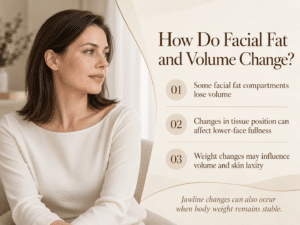
Facial fat is organised into separate compartments. With age, some compartments may lose volume while others can shift or become more prominent.
Reduced support in the mid-face may allow the lower face to look heavier. At the same time, fullness around the jaw or beneath the chin may soften the border between the face and neck.
Weight loss can also reduce facial volume and make skin laxity more visible. Weight gain may increase lower-face or under-chin fullness. However, jawline changes can occur even when body weight remains stable.
Does Bone Structure Affect Jawline Definition?
The facial skeleton provides support for the skin and soft tissues. Age-related changes in the jawbone and chin can gradually reduce this structural support.
A naturally small or less projected chin may also make the jawline appear softer from the side. This does not necessarily mean that the person has excessive fat or severe skin laxity.
During an assessment, the practitioner may consider whether the concern is primarily related to skin quality, tissue position or underlying facial structure.
Can the Muscles Influence the Lower Face?
Muscles can influence the shape and movement of the jawline. Strong jaw muscles may create a wider lower face, while other muscles can pull down on the corners of the mouth or lower-face tissues.
Muscle activity is only one part of the assessment. It should be considered together with the skin, fat, chin and overall facial proportions.
What Role Does Sun Exposure Play?
Ultraviolet exposure can contribute to collagen breakdown and reduced skin elasticity. Over time, sun-damaged skin may appear thinner, rougher, less even and less firm.
Sydney’s high levels of ultraviolet radiation make daily sun protection particularly important. Broad-spectrum sunscreen, protective clothing and avoiding unnecessary sun exposure can help reduce further damage.
Sun protection cannot reverse existing laxity, but it remains an important part of maintaining skin quality.
Why Can One Side Look Different?
Perfect facial symmetry is uncommon. Differences between the two sides of the jawline may relate to:
• Natural bone structure • Dental alignment • Preferred sleeping position • Chewing habits • Muscle strength • Previous injury or surgery • Uneven skin or volume changes • Lighting and camera angle
A practitioner should recognise normal asymmetry and avoid creating unrealistic expectations of perfect balance.
How Is an Ageing Jawline Assessed?
A lower-face assessment may include:
• Skin thickness and elasticity • Degree and location of laxity • Jowls • Facial volume distribution • Chin projection • Under-chin fullness • Jaw muscle size • Neck profile • Facial symmetry • Previous cosmetic procedures
The face may be examined from the front, side and three-quarter angles. Photographs may also be used to document the starting point and support treatment planning.
What Non-Surgical Options May Be Discussed?

The appropriate option depends on what is causing the loss of definition.
When skin laxity is the main concern, selected ultrasound, radiofrequency or laser-based treatments may be discussed. These treatments use different forms of energy and work at different tissue depths.
When skin quality is contributing to the concern, treatments focused on texture, hydration or collagen support may be considered. If fullness, muscle activity or facial proportions are the main factors, a different approach may be required.
A combined or staged plan may sometimes be appropriate, but every component should have a clear purpose.
What Results Are Realistic?
Non-surgical treatments may help suitable clients achieve a gradual improvement in skin firmness or lower-face definition. Results vary according to:
• Age • Genetics • Initial skin quality • Degree of laxity • Facial anatomy • Treatment selected • Individual response • Lifestyle and sun exposure
Non-surgical procedures cannot remove substantial excess skin or reproduce the result of a surgical facelift. No specific level of tightening or improvement can be guaranteed.
Jawline Assessment at Sky Beauty Sydney
Sky Beauty Cosmetic Clinic provides individual consultations for jawline, chin and lower-face concerns at two Sydney locations:
• Sydney CBD: Shop 1060A, World Square, 644 George Street, Sydney NSW 2000 • Macquarie Park: Shop 2054, Level 2, Macquarie Centre, Macquarie Park NSW 2113
Available technologies differ between the two clinics. During your consultation, the practitioner can assess the causes of your concern and discuss suitable options, possible risks, recovery, limitations, expected outcomes and total cost before you decide whether to proceed.