

Why Can Nasolabial Folds Look Deeper With Age?
Nasolabial folds are the natural creases that extend from the sides of the nose toward the corners of the mouth. They are a normal part of facial anatomy and can be visible at almost any age.
However, many people notice that these folds gradually appear deeper or more defined as they get older. This does not necessarily happen because of one isolated change. The appearance of nasolabial folds can be influenced by a combination of skin characteristics, facial structure, cheek contours, movement, genetics and natural changes that occur throughout adulthood.
For people researching Nasolabial Folds Sydney or Smile Lines Sydney, understanding these factors can provide useful context before considering any options.
Are Nasolabial Folds a Normal Part of the Face?
Yes. Nasolabial folds are normal anatomical features.
They form along the natural transition between the cheeks and the area around the mouth. They often become more noticeable when smiling because movement of the cheeks changes the contours of the mid-face.
Some people naturally have more visible nasolabial folds from a younger age, while others may notice them becoming more defined later in life.
For this reason, the presence of nasolabial folds alone should not be considered an indication of a particular skin problem.
Why Can Nasolabial Folds Change With Age?
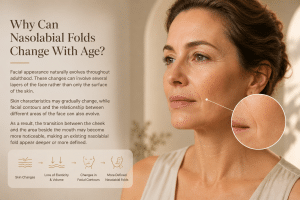
Facial appearance naturally evolves throughout adulthood.
These changes can involve several layers of the face rather than only the surface of the skin.
Skin characteristics may gradually change, while facial contours and the relationship between different areas of the face can also evolve.
As a result, the transition between the cheek and the area beside the mouth may become more noticeable.
This can make an existing nasolabial fold appear deeper or more defined.
How Do Changes in Skin Quality Affect Nasolabial Folds?
Skin naturally changes over time.
Characteristics such as elasticity, thickness, hydration and texture may gradually change as part of the ageing process.
These changes can influence how the skin sits over the underlying facial structures and how visible existing folds appear.
However, skin quality is only one factor.
A deeper-looking nasolabial fold does not necessarily mean that the skin itself is the main reason for the change.
Does the Cheek Area Influence Nasolabial Folds?
Yes. The cheeks and nasolabial area are closely connected.
The nasolabial fold sits near the transition between the cheek and the area surrounding the mouth.
As facial contours gradually change, this transition may become more defined.
Changes in the shape or distribution of facial tissues can also influence how light and shadow fall across this area.
As a result, the fold may look deeper even though the change involves a broader area of the face.
This is why an individual assessment may include the cheeks and mid-face rather than focusing only on the visible line.
Do Changes in Facial Volume Play a Role?
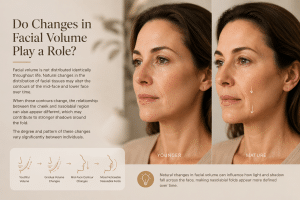
Facial volume is not distributed identically throughout life.
Natural changes in the distribution of facial tissues may alter the contours of the mid-face and lower face over time.
When these contours change, the relationship between the cheek and nasolabial region can also appear different.
For some people, this may contribute to stronger shadows around the fold.
The degree and pattern of these changes vary significantly between individuals.
Can Facial Structure Make Age-Related Changes More Noticeable?
Facial structure can influence how nasolabial folds appear at every age.
People have different cheek shapes, facial proportions and underlying anatomy.
Some facial structures naturally create a stronger transition between the cheeks and the area around the mouth.
As the face changes over time, these anatomical characteristics may influence how noticeable the nasolabial folds become.
This helps explain why two people of the same age can have very different smile lines.
Why Can One Side Become Deeper Than the Other?
Perfect facial symmetry is uncommon.
The two sides of the face may differ slightly in structure, cheek contours, tissue distribution and movement.
These natural differences may become more noticeable over time.
As a result, one nasolabial fold may appear deeper or more defined than the other.
During an individual consultation, a practitioner may consider the cheeks, mid-face, skin characteristics, facial proportions, symmetry and movement.
Does Repeated Smiling Cause Nasolabial Folds?
Smiling makes nasolabial folds more visible because the cheeks and surrounding facial tissues move during expression.
However, it would be an oversimplification to say that smiling alone causes deeper nasolabial folds.
Their appearance can reflect a combination of anatomy, skin characteristics, genetics, facial movement and natural changes over time.
Some people have noticeable folds even when their face is relaxed, while others mainly see them during smiling.
Why Are Nasolabial Folds Sometimes More Visible at Rest With Age?
When younger, some people may notice their nasolabial folds mainly when smiling.
Over time, the folds may become more visible even when the face is relaxed.
This can occur as the relationship between the skin, cheeks and surrounding facial tissues gradually changes.
The transition between facial areas may become more defined, creating a visible crease or shadow without strong facial movement.
The pattern is highly individual and does not occur in exactly the same way for everyone.
Can Sun Exposure Influence Their Appearance?
Long-term sun exposure can contribute to changes in skin characteristics.
Cumulative exposure may influence skin texture, elasticity and pigmentation, which can affect the overall appearance of facial lines and folds.
Using appropriate sun protection is therefore an important part of maintaining general skin health.
However, sun exposure does not explain every change in nasolabial folds. Facial anatomy and natural age-related changes may still play significant roles.
Can Weight Changes Make Nasolabial Folds Look Different?
Changes in body weight can affect facial contours in some people.
Weight loss or weight gain may alter how facial volume is distributed, particularly around the cheeks and lower face.
Depending on an individual’s anatomy, this may make nasolabial folds appear more or less noticeable.
Because everyone’s facial structure is different, the effect of weight changes cannot be predicted from age alone.
Why Do Nasolabial Folds Look Deeper in Certain Lighting?
Sometimes the fold itself has not changed as much as it appears to have changed.
Lighting can significantly influence facial appearance.
Nasolabial folds create natural transitions between facial contours. Strong overhead or side lighting can create shadows along these transitions and make the folds appear deeper.
Softer frontal lighting may make them appear less noticeable.
This is particularly relevant when comparing photographs taken years apart. Differences in lighting, camera angle, lens distance and facial expression can make direct comparisons difficult.
Are Deeper Nasolabial Folds Always Related to Age?

No.
Age is only one factor.
Some younger adults naturally have prominent nasolabial folds because of their facial structure or genetics, while some older adults have relatively subtle folds.
Other factors that may influence their appearance include:
- Facial anatomy and proportions
- Cheek and mid-face contours
- Skin characteristics
- Genetics
- Facial movement
- Changes in facial volume
- Weight changes
- Environmental influences
- Lighting and photography
For this reason, age alone cannot explain why a person’s nasolabial folds appear more noticeable.
Why Is an Individual Assessment Important?
When someone is concerned about deeper nasolabial folds, it can be tempting to focus entirely on the visible crease.
However, the appearance of the fold may be influenced by several surrounding structures.
During a professional consultation, a practitioner may consider the cheeks, mid-face, skin characteristics, facial proportions, symmetry and movement.
The face may also be assessed both at rest and during expression.
Relevant medical history and previous cosmetic procedures may also be discussed where appropriate.
This broader assessment can help provide context about the factors that may influence an individual’s facial appearance.
Nasolabial Folds Sydney: Understanding Changes Over Time
Nasolabial folds can appear deeper with age because the face naturally changes throughout adulthood.
Changes in skin characteristics, facial contours, tissue distribution and the relationship between the cheeks and lower face may all contribute. Genetics, facial structure, movement and environmental factors can also influence how noticeable the folds become.
For people researching Nasolabial Folds Sydney or Smile Lines Sydney, it is important to remember that visible folds are a normal facial feature and that their appearance varies considerably between individuals.
At Sky Beauty Cosmetic Clinic in Sydney, our approach begins with an individual consultation and facial assessment. Our practitioners consider your facial structure, skin characteristics, symmetry, movement, relevant history and personal concerns before discussing whether any options may be appropriate for your individual circumstances.
If changes in your nasolabial folds or smile lines are something you would like to better understand, a consultation at Sky Beauty Cosmetic Clinic provides an opportunity to discuss your concerns and receive an individual assessment.