

Why Is a Whole-Face Assessment Important When Evaluating the Nasal Base?
When someone is concerned about a flat, recessed or hollow looking area beside the nose, it can be tempting to focus entirely on that small region.
However, the nasal base does not exist in isolation.
Its appearance can be influenced by the nose, cheeks, mid-face, upper lip, nasolabial folds, chin and overall facial proportions. This is why a whole-face assessment can be particularly important when evaluating nasal base concerns.
For people researching Nasal Base Sydney or considering a Nasal Base Assessment Sydney, understanding the entire facial structure can provide more useful information than simply looking at one shadow or hollow.
At Sky Beauty Cosmetic Clinic, our facial assessments take into account the relationship between different facial features before suitable cosmetic options are discussed.
What Is the Nasal Base?
The nasal base generally refers to the lower supporting area of the nose and the surrounding region where the nose meets the central face and upper lip.
Some people naturally have greater projection in this area, while others have a flatter or slightly recessed appearance.
A flatter nasal base may create a visible shadow beside the nose or influence how the nose appears from the side.
However, what looks like a nasal base concern may sometimes be influenced by surrounding facial structures.
This is where whole-face assessment becomes important.
Why Shouldn’t the Nasal Base Be Assessed Alone?
Facial appearance is based on relationships and proportions.
For example, the same nasal base may look different depending on the projection of the cheeks or nose.
If the nose projects further forward, the nasal base may appear relatively recessed.
If the cheeks have strong projection, the transition beside the nose may create more noticeable shadowing.
Similarly, the position of the upper lip can influence how the nasal base appears from the side.
This means that focusing only on the deepest point beside the nose may not explain what is actually creating the concern.
How Does the Mid-Face Influence the Nasal Base?
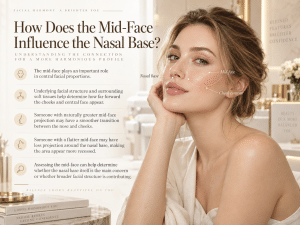
The mid-face plays an important role in central facial proportions.
Underlying facial structure and surrounding soft tissues help determine how far forward the cheeks and central face appear.
Someone with naturally greater mid-face projection may have a smoother transition between the nose and cheeks.
Someone with a flatter mid-face may have less projection around the nasal base, making the area appear more recessed.
During a Nasal Base Assessment Sydney, evaluating the mid-face can therefore help determine whether the nasal base itself is the main concern or whether broader facial structure is contributing.
Why Are the Cheeks Important?
The cheeks sit immediately beside the nose and strongly influence the contours of the mid-face.
Differences in cheek projection can change how light and shadow fall around the nasal base.
A relatively projected cheek next to a flatter nasal base may create a stronger difference in depth.
Age related changes in cheek soft tissues can also make an existing hollow beside the nose appear more noticeable.
At Sky Beauty Cosmetic Clinic Sydney, cheek structure is therefore considered as part of the overall assessment rather than treating the nasal base as an independent feature.
What About the Nasolabial Folds?
Nasolabial folds are the natural creases extending from the sides of the nose towards the corners of the mouth.
Because the upper part of these folds begins close to the nasal base, the two areas can sometimes be confused.
A person may describe their concern as a flat nasal base when they are actually noticing a deeper nasolabial fold.
Alternatively, reduced projection around the nasal base may create a shadow that makes the upper portion of the fold appear more noticeable.
A whole-face assessment can help distinguish between these possibilities.
Why Is the Upper Lip Evaluated?
The nasal base sits directly above the upper lip, so their relationship is particularly important when assessing the side profile.
The position and projection of the upper lip can change how the nasal base appears.
For example, a relatively projected upper lip may create a different visual relationship with the nose compared with a less projected lip.
Dental and jaw structure may also influence the profile.
This is why assessing only the nasal base may provide an incomplete understanding of the central face.
Can the Chin Affect How the Nasal Base Looks?
The chin is further away from the nasal base, but it still contributes to overall profile balance.
A relatively recessed chin can make the nose appear more prominent.
When the nose appears more prominent, the nasal base and mid-face may seem flatter by comparison.
This illustrates an important principle of facial assessment:
A concern in one area can sometimes be influenced by a feature located somewhere else on the face.
The whole profile therefore needs to be considered.
Why Is Facial Symmetry Important?
No face is perfectly symmetrical.
One side of the nasal base may naturally appear slightly different from the other. Cheek projection, nostril shape and soft tissue distribution can also vary between sides.
Looking at the entire face allows the practitioner to understand whether an apparent difference around the nasal base is part of normal facial asymmetry.
This is particularly important when someone has become focused on a small difference visible in photographs.
Does Age Need to Be Considered?
Yes.
A person may have had a relatively flat nasal base for many years but only begin noticing it as they get older.
Age related changes in skin elasticity, cheek contours, facial volume distribution and soft tissue support can make existing structural characteristics more visible.
Therefore, the assessment should consider both natural anatomy and changes that may have occurred over time.
The goal is to determine whether the concern is primarily structural, age related or influenced by several factors.
Why Are Different Facial Angles Evaluated?
The nasal base can look very different depending on the viewing angle.
From the front, the practitioner can assess symmetry and the relationship between the nose and cheeks.
From a 45 degree angle, shadows around the nasal base and nasolabial folds may become more visible.
From the side, the relationship between the nose, nasal base, upper lip and chin can be assessed more clearly.
Looking at multiple angles provides a more complete understanding than relying on a single selfie or photograph.
Does a Hollow Area Always Mean Volume Is Missing?
No.
This is one of the reasons whole-face assessment is so important.
A hollow beside the nose may be related to natural bone structure, nasal base projection, cheek anatomy, soft tissue distribution or age related changes.
Simply seeing a depression does not automatically mean that additional volume is required.
Before discussing any cosmetic approach, the practitioner should understand what is actually creating the appearance.
What Is Considered During a Whole-Face Assessment?
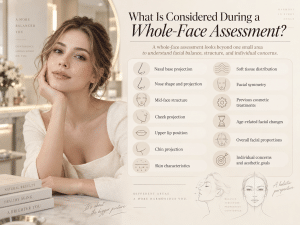
During a facial consultation at Sky Beauty Cosmetic Clinic Sydney CBD or Macquarie Park, the assessment may consider:
- Nasal base projection
- Nose shape and projection
- Mid-face structure
- Cheek projection
- Nasolabial folds
- Upper lip position
- Chin projection
- Skin characteristics
- Soft tissue distribution
- Facial symmetry
- Previous cosmetic treatments
- Age related facial changes
- Overall facial proportions
Your individual concerns and aesthetic goals are also an important part of the consultation.
Why Does This Matter Before Treatment?
Two people may point to exactly the same area beside the nose and describe the same concern, yet the reason behind it may be completely different.
One person may naturally have less mid-face projection.
Another may primarily have a more noticeable nasolabial fold.
Someone else may have experienced changes in the surrounding cheek tissues over time.
If the underlying causes are different, the approach should not automatically be the same.
This is why assessment comes before treatment planning.
Looking at the Whole Face Can Change the Question
When someone first notices a hollow beside the nose, the question may be:
“What should I do to this area?”
After a whole-face assessment, a more useful question may become:
“What is actually creating this appearance?”
At Sky Beauty Cosmetic Clinic Sydney CBD and Macquarie Park, our practitioners consider the nasal base within the context of the entire face before discussing suitable cosmetic options.
If you are researching Nasal Base Sydney, a whole-face assessment can help clarify whether the concern relates primarily to the nasal base, surrounding mid-face structures, natural anatomy or changes that have developed over time.
Because when it comes to facial balance, understanding the relationship between features is often more important than focusing on one area alone.