

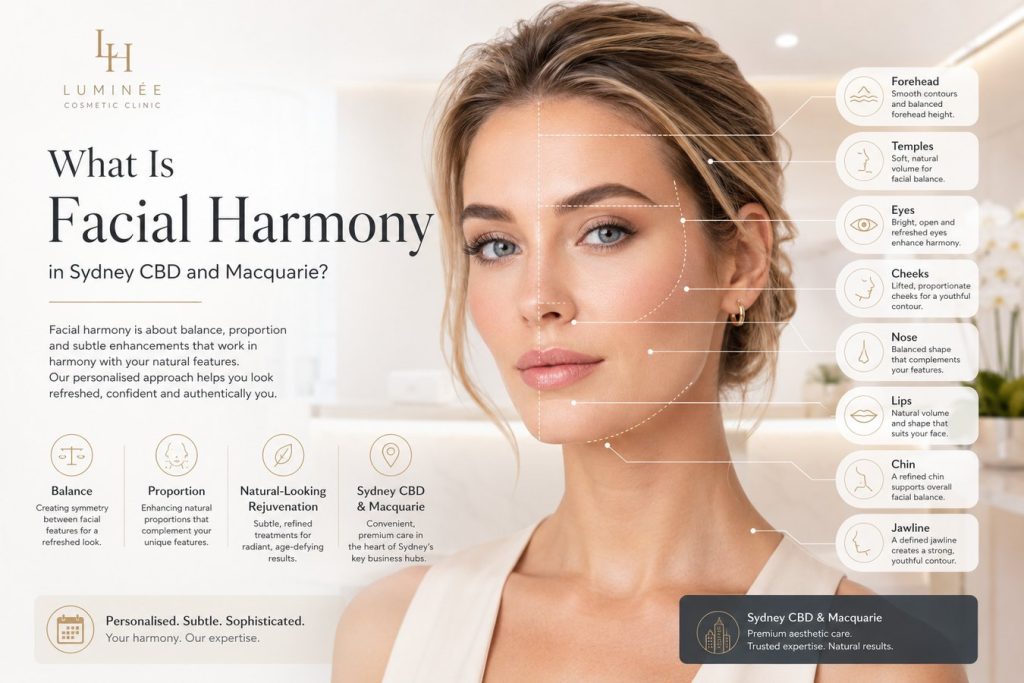
One of the most important concepts in modern aesthetic medicine is facial harmony.
While many people focus on individual features such as the nose, lips, cheeks, or jawline, experienced practitioners often look at the face as a whole. In fact, facial harmony is often considered more important than any single feature when assessing overall attractiveness, balance, and facial rejuvenation.
Many patients visiting cosmetic clinics in Sydney CBD and Macquarie Park are not necessarily seeking dramatic changes. Instead, they often want to look:
- More refreshed
- More balanced
- Less tired
- Healthier
- Naturally rejuvenated
Understanding facial harmony can help explain why some faces appear youthful and balanced even without perfect features.
What Is Facial Harmony?
Facial harmony refers to the balance and proportion between different facial features.
Rather than focusing on one specific area, facial harmony considers how the entire face works together.
This includes the relationship between:
- Forehead
- Temples
- Eyes
- Cheeks
- Nose
- Lips
- Chin
- Jawline
A harmonious face is not necessarily a perfect face.
In fact, many attractive individuals have unique features that contribute to their individuality and character.
The key factor is balance.
When facial proportions work together naturally, the face often appears more aesthetically pleasing and youthful.
Why Facial Harmony Matters More Than Individual Features
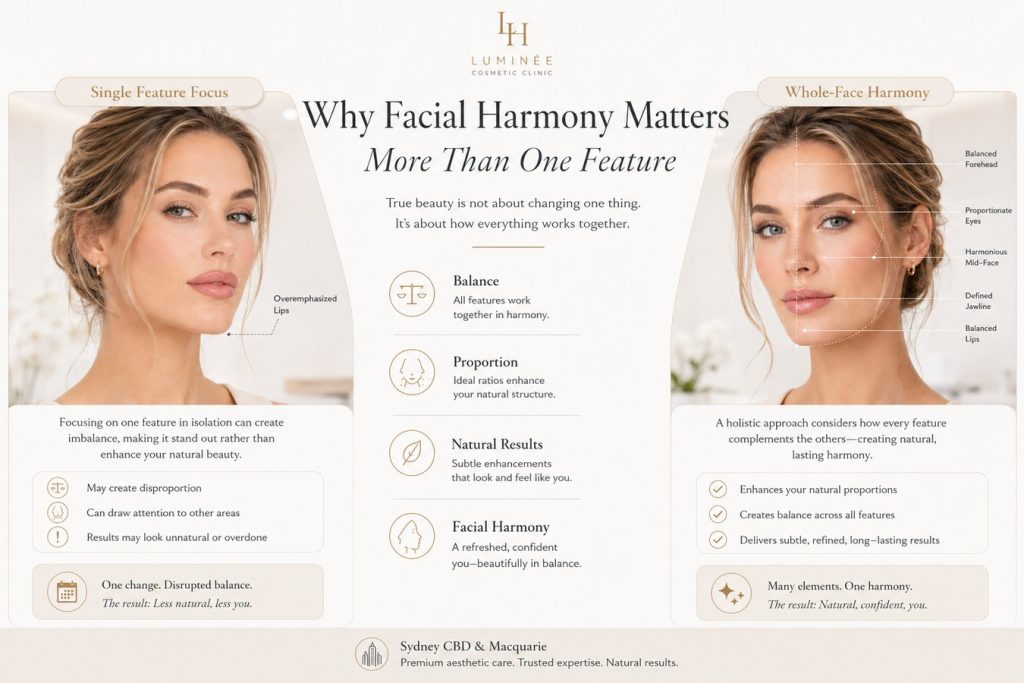
A common misconception is that improving one facial feature automatically improves overall appearance.
In reality, the face functions as a complete structure.
For example:
- Strong cheek definition may appear less balanced if facial proportions are uneven.
- A defined jawline may not create harmony if the chin lacks structural support.
- Changes in one area can influence how other features are perceived.
This is why modern aesthetic consultations often focus on overall facial assessment rather than isolated concerns.
The goal is usually to support facial balance rather than change a single feature.
Understanding Facial Proportions
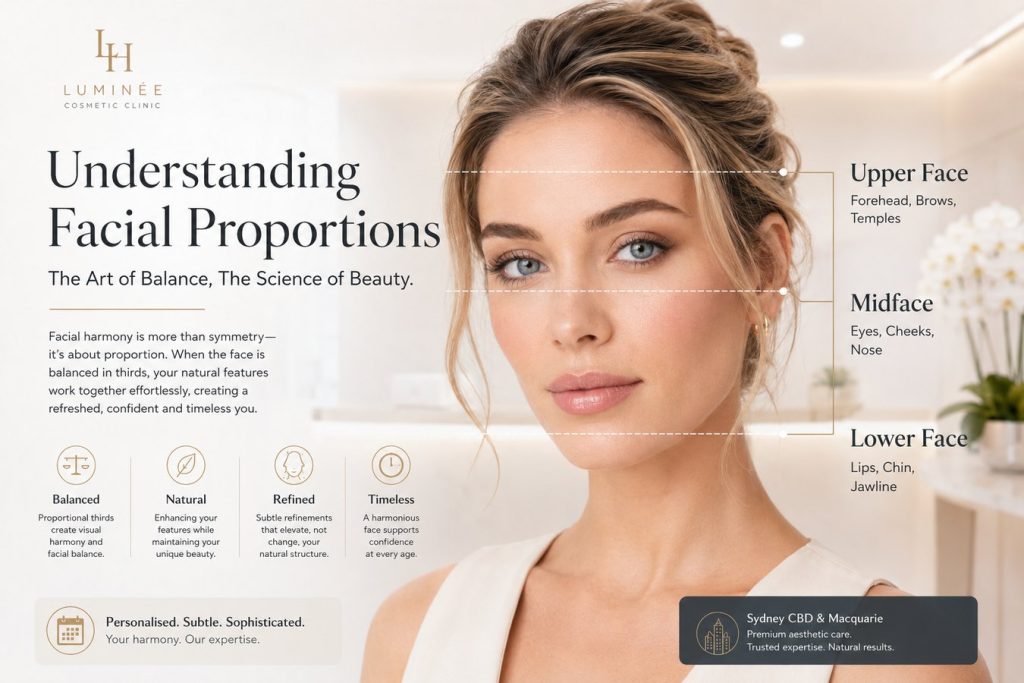
Facial harmony is closely linked to facial proportions.
Historically, artists, sculptors, and medical professionals have studied facial proportions to better understand beauty and symmetry.
Although every face is unique, practitioners often assess three facial regions:
Upper Face
Includes:
- Forehead
- Brows
- Temples
This area contributes to facial framing and overall structure.
Midface
Includes:
- Eyes
- Cheeks
- Nose
The midface plays a major role in facial support and youthful appearance.
Lower Face
Includes:
- Lips
- Chin
- Jawline
This area influences facial definition and profile balance.
Rather than relying on strict measurements, practitioners assess how these areas relate to one another.
Facial Harmony and Ageing
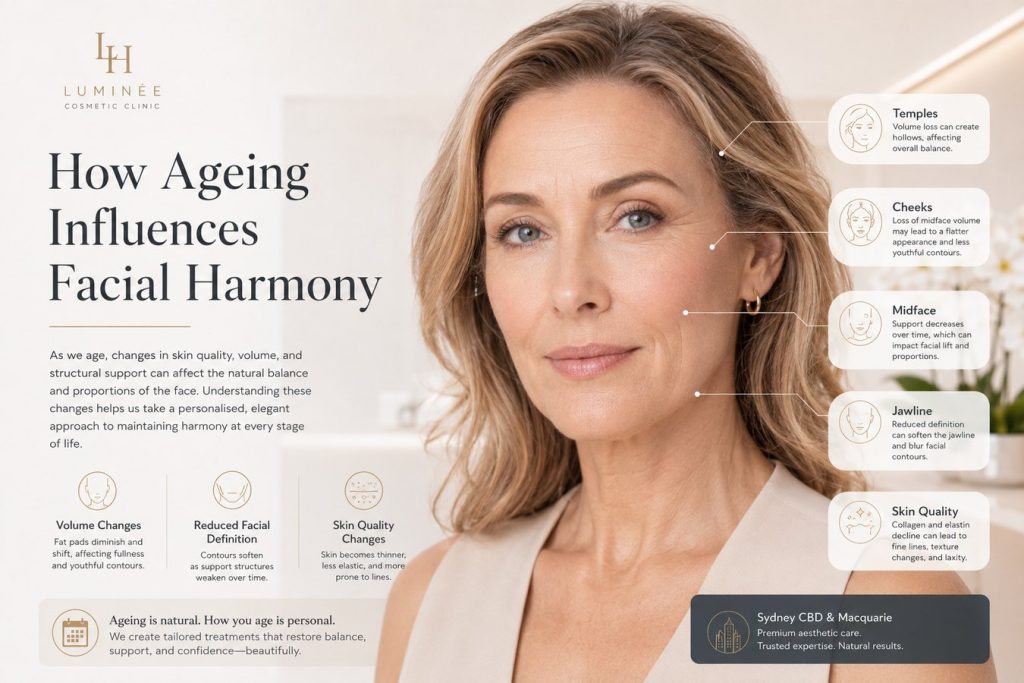
One reason facial harmony becomes such an important topic is that ageing affects facial balance.
As we age, changes occur within:
- Skin
- Fat compartments
- Connective tissues
- Muscles
- Bone structure
These changes can gradually alter facial proportions.
Common examples include:
Volume Changes
Volume changes may occur in areas such as:
- Temples
- Cheeks
- Midface
This can affect facial support and balance.
Reduced Facial Definition
Changes in structural support may contribute to:
- Softer jawlines
- Altered facial contours
- Less defined facial shape
Skin Quality Changes
Changes in collagen and elastin production may affect:
- Skin firmness
- Elasticity
- Overall appearance
Together, these changes influence facial harmony and contribute to visible ageing.
Why Facial Harmony Is Important for Asian Faces
Asian facial anatomy often differs from Western facial anatomy.
Common characteristics may include:
- Wider facial proportions
- Fuller midface structure
- Different skeletal support patterns
- Stronger facial width
Because of these differences, facial harmony assessments should always be individualised.
Many Asian patients prioritise:
- Natural-looking outcomes
- Facial balance
- Preservation of identity
- Respect for ethnic features
rather than attempting to conform to a universal beauty standard.
This personalised approach is increasingly recognised in modern aesthetic medicine.
Why Some People Look Tired Despite Looking Healthy

One of the most common complaints heard during cosmetic consultations is:
> “I feel fine, but I always look tired.”
This often relates to changes in facial harmony.
Subtle shifts in:
- Temple volume
- Midface support
- Facial contours
- Skin quality
can influence how refreshed a person appears.
Even when wrinkles are minimal, changes in facial balance may create the impression of fatigue or ageing.
Facial Harmony and Natural-Looking Results
Many patients in Sydney CBD and Macquarie Park specifically request natural-looking outcomes.
This is one reason facial harmony has become such an important principle.
Rather than focusing on dramatic changes, practitioners often prioritise:
- Facial balance
- Individual anatomy
- Long-term planning
- Healthy ageing
- Natural proportions
The most successful outcomes are often the least obvious.
Friends and family may simply comment that someone looks healthier, happier, or more refreshed.
Why a Comprehensive Consultation Matters

Because facial harmony involves the entire face, a quality consultation should include a comprehensive assessment.
An appropriately qualified healthcare professional may evaluate:
Facial Structure
Understanding underlying anatomy helps identify factors influencing appearance.
Facial Proportions
Assessment of balance between facial regions contributes to personalised planning.
Skin Quality
Healthy skin plays a significant role in overall facial appearance.
Individual Goals
Every patient has different concerns, preferences, and expectations.
A personalised consultation allows these factors to be considered carefully.
Questions to Ask During a Consultation
If facial harmony is important to you, consider asking:
- How do you assess facial balance?
- What factors contribute to my concerns?
- How do you prioritise natural-looking outcomes?
- How will my treatment plan be personalised?
- How does facial harmony influence your recommendations?
These discussions can help patients better understand the consultation process and treatment philosophy.
Healthy Ageing and Facial Harmony
Modern cosmetic medicine increasingly focuses on healthy ageing rather than dramatic transformation.
This philosophy encourages:
- Realistic expectations
- Long-term planning
- Natural-looking outcomes
- Skin health
- Facial balance
Many patients simply want to look refreshed and confident while maintaining the features that make them unique.
Final Thoughts
Facial harmony is one of the most important principles in modern facial rejuvenation. Rather than focusing on individual features in isolation, it considers how the entire face works together to create balance, proportion, and a naturally attractive appearance.
Whether you are considering a cosmetic consultation in Sydney CBD, Macquarie Park, North Ryde, Chatswood, or surrounding suburbs, understanding facial harmony can help you make more informed decisions and develop realistic expectations regarding facial ageing and aesthetic goals.
Disclaimer
This article is intended for general educational purposes only and does not constitute medical advice. Any medical or cosmetic treatment should only be undertaken following consultation with an appropriately qualified healthcare professional. Treatment suitability, risks, benefits, and alternatives should be assessed on an individual basis.