

What Cosmetic Approaches May Be Discussed for Nasolabial Folds in Sydney?

Nasolabial folds are the natural creases that extend from the sides of the nose toward the corners of the mouth. Often referred to as smile lines, they are a normal part of facial anatomy and can vary considerably between individuals.
For people researching Nasolabial Folds Sydney or Smile Lines Sydney, it is common to wonder what cosmetic approaches may be discussed during a professional consultation.
There is no single approach that is appropriate for every person. Nasolabial folds may be influenced by facial structure, cheek contours, skin characteristics, facial movement, genetics and natural changes over time.
For this reason, a cosmetic consultation usually begins by understanding the individual face rather than selecting an approach based only on the appearance of the fold.
Why Is Assessment Important Before Discussing Cosmetic Options?
Nasolabial folds can look similar while having different contributing factors.
One person’s folds may be strongly influenced by natural facial structure. Another person’s concern may involve changes in skin quality or facial contours. In many cases, several factors may contribute at the same time.
Before discussing cosmetic management, a practitioner may assess the face from different angles and consider how the cheeks, mid-face and lower face relate to one another.
This helps create a more individual understanding of the concern.
Is the Nasolabial Fold Assessed on Its Own?
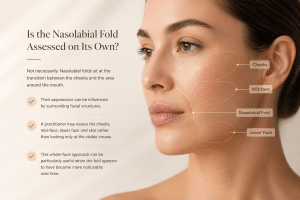
Not necessarily.
Nasolabial folds sit at the transition between the cheeks and the area around the mouth. Their appearance can therefore be influenced by surrounding facial structures.
A practitioner may assess the cheeks, mid-face, lower face and skin rather than looking only at the visible crease.
This whole-face approach can be particularly useful when the fold appears to have become more noticeable over time.
What Role Does Skin Quality Play?
Skin characteristics may be one consideration during a cosmetic assessment.
Factors such as texture, hydration, elasticity and general skin condition can influence how facial lines and folds appear.
Depending on the assessment, general approaches that support skin quality may be discussed where appropriate.
However, improving the overall condition of the skin is different from addressing the structural factors that may contribute to a facial fold.
A practitioner should explain this distinction during the consultation.
Can Skin-Focused Cosmetic Approaches Be Discussed?
Depending on the individual’s skin characteristics, a practitioner may discuss cosmetic approaches focused on general skin quality, texture or overall skin condition.
The suitability of any approach depends on the individual.
Factors such as skin type, medical history, previous procedures, sensitivity and the person’s concerns should be considered before deciding whether a particular cosmetic service is appropriate.
It is also important to understand that a skin-focused approach may not address every factor contributing to the appearance of nasolabial folds.
Can Energy-Based or Device-Based Approaches Be Considered?
Some cosmetic consultations may include discussion of device-based approaches where these are appropriate for the individual’s broader skin concerns.
Different technologies are designed for different purposes and are not interchangeable.
Whether a device-based approach is appropriate depends on factors such as skin characteristics, the area being assessed, relevant medical history and the person’s individual goals.
A professional assessment is therefore important before deciding whether this type of approach should form part of a cosmetic management plan.
Why Might the Cheek and Mid-Face Be Discussed?
People sometimes arrive at a consultation wanting to focus exclusively on the visible nasolabial fold.
However, the practitioner may also assess the cheek and mid-face.
This is because the shape and contour of the cheek can influence the transition toward the area around the mouth.
Understanding this relationship can help explain why simply looking at the depth of the fold may not provide a complete picture.
The purpose of assessing surrounding areas is to understand facial anatomy rather than assume that every nasolabial fold should be approached in the same way.
Does Facial Movement Affect the Discussion?
Yes.
Nasolabial folds usually become more visible when smiling because movement of the cheeks changes the contours of the face.
A practitioner may therefore observe your face both at rest and during natural expression.
If a fold is mainly visible during smiling, this provides different information from a fold that remains prominent when the face is relaxed.
Understanding facial movement can help provide context when discussing your concerns.
What About Medical Cosmetic Options?
Depending on your individual assessment, an appropriately qualified health practitioner may discuss considerations relevant to your concerns. This may include your medical history, previous procedures, individual anatomy, suitability, potential risks and other clinical factors. Any recommendations should be based on your individual circumstances following a professional consultation.
This allows the discussion to be based on the person’s individual circumstances rather than general online information.
Why Isn’t There One Standard Approach for Smile Lines?
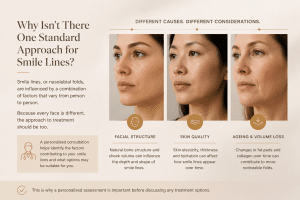
Nasolabial folds are not identical from person to person.
Two people may have folds of similar depth but very different facial anatomy.
Age can also be misleading. A younger person may naturally have prominent folds because of facial structure, while an older person may have relatively subtle folds.
For this reason, choosing a cosmetic approach based only on age or the apparent depth of a line may overlook important individual factors.
What Should Be Considered Before Any Cosmetic Procedure?
Before deciding whether to proceed with a cosmetic procedure, it is important to understand what is being proposed and why it may or may not be appropriate for you.
Depending on the procedure being discussed, relevant considerations may include:
- Your facial anatomy
- Skin characteristics
- Medical history
- Previous cosmetic procedures
- Current medications where relevant
- Potential risks and limitations
- Expected recovery or aftercare
- Alternative approaches
- Your individual goals and expectations
You should also have an opportunity to ask questions before making a decision.
Can More Than One Area of the Face Be Assessed?
Yes.
A facial assessment does not necessarily need to focus only on the area that first attracted your attention.
Because different facial areas are structurally connected, a practitioner may examine the relationship between the cheeks, nasolabial region, mouth and lower face.
This does not mean that every area requires cosmetic management.
Rather, examining the whole face can provide useful information about why a particular feature appears the way it does.
What Questions Should You Ask During a Consultation?
If you are researching Nasolabial Folds Sydney, useful questions may include:
- What factors are contributing to the appearance of my nasolabial folds?
- Is my facial structure influencing what I see?
- Are my skin characteristics contributing?
- Why is one side more noticeable than the other?
- Are the folds mainly visible during movement or also at rest?
- What cosmetic approaches may be appropriate for my individual circumstances?
- What are the potential risks and limitations of any option being discussed?
- Are there alternatives?
- What aftercare or follow-up may be required?
A consultation should give you an opportunity to understand the reasoning behind any cosmetic approach being considered.
Should You Decide on a Procedure Before Your Consultation?
You do not need to arrive with a particular procedure already selected.
Online research can be useful for learning about facial anatomy and preparing questions, but it cannot determine which approach is appropriate for an individual.
Beginning with your concern rather than a specific procedure allows the practitioner to assess the area before discussing suitable options.
You should also have the opportunity to consider the information provided before deciding whether you want to proceed.
Nasolabial Folds Sydney: Choosing an Individual Approach
There is no universal cosmetic approach for nasolabial folds.
Their appearance may be influenced by facial structure, cheek contours, skin characteristics, movement, genetics and natural changes over time.
Depending on the individual assessment, discussions may include general skin-focused care, suitable cosmetic technologies or other approaches relevant to the individual’s concerns. An appropriately qualified health professional can assess individual suitability, risks and other clinical considerations during a consultation.
For people researching Nasolabial Folds Sydney or Smile Lines Sydney, starting with an individual facial assessment can provide a clearer understanding of what is contributing to the concern.
At Sky Beauty Cosmetic Clinic in Sydney, our approach begins with a personalised consultation and facial assessment. Our practitioners consider your facial structure, skin characteristics, movement, symmetry, relevant history and personal concerns to help you better understand the factors contributing to the appearance of your nasolabial folds.
If you are concerned about nasolabial folds or smile lines, a consultation at Sky Beauty Cosmetic Clinic provides an opportunity to better understand your facial characteristics, ask questions and discuss appropriate options based on an individual assessment.