

What Causes Jawline Sagging and What Can Be Done About It?

The jawline can gradually appear softer, heavier or less defined over time. This change is often described as jawline sagging, but it is rarely caused by one factor alone.
Skin quality, facial fat, bone structure, muscle activity, genetics and changes in the neck can all influence the lower face. This is why an individual assessment is important before considering cosmetic treatment.
At Sky Beauty Cosmetic Clinic Sydney CBD and Macquarie Park, the jawline is assessed together with the chin, cheeks and neck to identify the main factors affecting its appearance.
Why Does the Jawline Change With Age?
Ageing affects several layers of the face. Collagen and elastin gradually decline, facial fat compartments may shift, and the underlying bone structure can change.
These changes may lead to:
• Reduced skin firmness • Loose skin around the lower face • Jowls near the corners of the mouth • Less separation between the jawline and neck • Changes in chin projection • Heaviness around the lower cheeks • Fine lines and crepey skin
The degree and timing of these changes vary between individuals.
Can Reduced Collagen Cause Jawline Sagging?
Collagen provides structural support to the skin, while elastin allows it to stretch and return to its original position.
As collagen production decreases, the skin may become thinner and less able to maintain a firm appearance. Sun exposure, smoking, hormonal changes and genetics may accelerate this process.
Reduced collagen can contribute to mild laxity, but it may not be the only cause of a less defined jawline.
How Do Facial Fat Changes Affect the Jawline?
Facial fat is arranged in separate compartments. With age, some compartments may reduce in volume while others descend or become more noticeable.
Fullness from the lower cheeks may shift towards the jawline, contributing to the appearance of jowls. Localised fat beneath the chin can also reduce the visible angle between the jaw and neck.
A fuller jawline does not necessarily mean a person has gained weight. Changes in fat distribution can occur even when body weight remains stable.
Does Bone Structure Influence Jawline Definition?
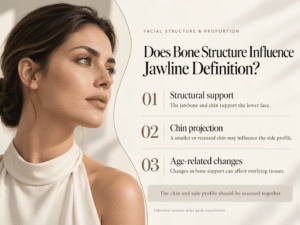
The lower face is supported by the jawbone and chin. A naturally small or recessed chin may make the jawline appear shorter or less defined from the side.
Age-related changes in facial bone can also affect support for the overlying tissues. When this structural support decreases, skin and soft tissue may appear looser.
This is why the chin and side profile should be assessed as part of a jawline consultation.
Can Muscle Activity Affect the Lower Face?
Several muscles influence the appearance of the jawline and neck. Some pull the lower face downwards, while others affect the width and shape of the jaw.
Strong chewing muscles may create a wider lower face. Neck muscle activity can also contribute to visible bands or downward tension around the jawline.
Muscle-related concerns require a different treatment discussion from loose skin, facial fat or reduced structural support.
What Role Does the Neck Play?
The jawline and neck are visually connected. Even when the jaw itself has not changed significantly, loose neck skin or fullness beneath the chin may make the border of the jaw appear less defined.
During an assessment, the practitioner may consider:
• Skin beneath the chin • Localised under-chin fullness • Neck skin laxity • Neck muscle activity • Chin projection • The angle between the jaw and neck • Posture and head position
Treating the jawline without considering the neck may lead to an incomplete treatment plan.
Can Weight Changes Cause Jawline Sagging?
Weight gain may increase facial or under-chin fullness, while significant weight loss may leave the skin looking looser.
However, jawline sagging can also occur without any major change in body weight. Ageing, genetics, skin quality and natural facial structure may still alter the appearance of the lower face.
Two people at the same weight can have very different jawlines because their bone structure, fat distribution and skin elasticity are different.
What Can Be Done About a Sagging Jawline?
The appropriate approach depends on the main cause and the degree of change. Options discussed during a cosmetic consultation may include:
• Skin-firming treatments • Treatments intended to support skin quality • Approaches for localised under-chin fullness • Treatments addressing muscle activity • Strategies focused on facial structure and proportion • Surgical referral for significant tissue laxity
Not every person requires treatment, and not every treatment is suitable for every type of sagging.
Can Energy-Based Treatments Help?
Energy-based treatments may be considered for selected clients with mild to moderate skin laxity.
Depending on the device, energy-based treatments may be considered to address selected concerns involving skin firmness.
Results vary according to the technology, treatment area, skin condition and individual response. These treatments cannot remove substantial excess skin or reproduce the results of surgery.
Can Skin Quality Treatments Improve the Jawline?
When the concern involves thin, dry or crepey skin, treatments focused on overall skin quality may be discussed.
Treatments focused on hydration and texture may help improve the appearance of skin quality. However, skin quality treatment alone may not substantially change jowls caused by descending tissue, under-chin fullness or reduced structural support.
The practitioner should explain which aspect of the jawline each proposed treatment is intended to address.
When May Surgery Be More Appropriate?
Non-surgical treatment has limitations. Surgical assessment may be more appropriate when there is:
• Significant hanging skin • Pronounced jowling • Substantial neck laxity • Large folds beneath the chin • A desire for a major or immediate change • A need to remove excess tissue
A responsible consultation should explain when a non-surgical approach is unlikely to meet the client’s expectations.
What Is Assessed During a Jawline Consultation?
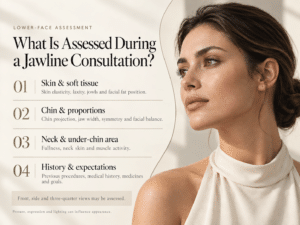
A lower-face assessment may consider:
• Skin thickness and elasticity • Degree of jawline laxity • Position of facial fat • Presence of jowls • Chin shape and projection • Jaw width and symmetry • Under-chin fullness • Neck skin and muscle activity • Facial proportions • Previous cosmetic procedures • Medical history and current medications • Personal goals and expectations
The face may be examined from the front, side and three-quarter views. Expressions, posture, lighting and camera angle can all influence how the jawline appears.
What Results Are Realistic?
Non-surgical treatments may offer gradual, individualised changes, depending on the treatment and the person’s concerns.
The outcome may be influenced by:
• Age and genetics • Bone structure • Skin quality • Degree of laxity • Facial fat distribution • Muscle activity • Treatment selection • Lifestyle and sun exposure • Individual healing and collagen response
A specific degree of tightening or definition cannot be guaranteed.
Jawline Assessment at Sky Beauty Sydney
Sky Beauty Cosmetic Clinic offers lower-face and jawline consultations at its Sydney CBD and Macquarie Park locations.