

Understanding the Difference Between Skin Repair and Skin Filling
As aesthetic medicine continues to evolve, patients are increasingly exposed to a wide range of treatment options. Two concepts that are often discussed—but frequently misunderstood—are skin repair and skin filling.
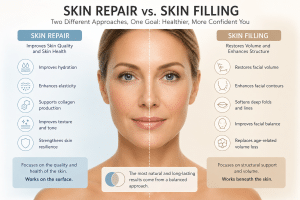
While both approaches can contribute to facial rejuvenation, they serve very different purposes. Understanding the distinction can help patients make more informed decisions about their aesthetic goals and treatment options.
What Is Skin Filling?
Skin filling focuses on restoring lost volume and enhancing facial structure.
As part of the natural ageing process, the face gradually loses fat, collagen, and bone support. These changes can lead to hollow areas, volume loss, and altered facial contours.
Skin filling treatments are designed to address these structural concerns by adding support beneath the skin.
Common goals of skin filling include:
- Restoring facial volume
- Enhancing facial contours
- Improving facial balance
- Softening deeper folds
- Replacing age-related volume loss
The primary objective is structural enhancement rather than improving the biological condition of the skin itself.
What Is Skin Repair?
Skin repair focuses on improving the health, function, and quality of the skin.
Rather than adding volume, skin repair treatments aim to support the skin’s natural regenerative processes. These approaches target concerns related to skin texture, elasticity, hydration, and overall skin condition.
The goal is to encourage healthier skin from within.
Skin repair strategies may focus on:
- Supporting collagen production
- Improving skin hydration
- Enhancing elasticity
- Promoting tissue regeneration
- Improving skin texture
- Strengthening skin resilience
Instead of changing facial shape, skin repair aims to improve the quality of the skin covering that structure.
Why the Difference Matters
Many people assume that volume loss is the primary reason for an aged appearance. While volume changes are important, skin quality often plays an equally significant role.
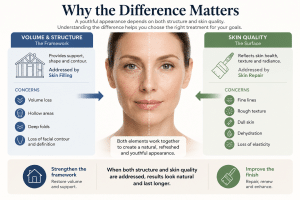
A person may have excellent facial volume yet still experience:
- Fine lines
- Rough texture
- Dull skin
- Enlarged pores
- Reduced elasticity
- Dehydration
In these situations, restoring volume alone may not address the underlying concern.
Similarly, a person with healthy, radiant skin may appear youthful even if some age-related volume loss is present.
Structure Versus Surface
One simple way to understand the difference is to think of a house.
The framework of the house represents facial structure, while the exterior paint and finish represent skin quality.
If the framework weakens, structural support may be needed.
If the paint becomes damaged or weathered, repair and restoration are required.
Adding more framework will not fix peeling paint, just as improving skin quality will not completely replace lost facial support.
Both elements contribute to the overall result.
The Growing Importance of Skin Repair
Modern aesthetic medicine is increasingly recognising the value of skin quality.
Research and clinical experience continue to demonstrate that healthy skin contributes significantly to a youthful and refreshed appearance.
Patients are becoming more interested in treatments that:
- Improve skin health
- Deliver natural-looking results
- Support long-term skin quality
- Encourage gradual improvement
- Focus on prevention as well as correction
This shift has helped drive the growth of regenerative aesthetic treatments that prioritise skin repair.
Can Skin Repair Replace Skin Filling?
Not always.
Skin repair and skin filling address different concerns.
Skin repair may improve:
- Texture
- Elasticity
- Hydration
- Skin firmness
- Overall skin quality
Skin filling may be more appropriate when concerns involve:
- Significant volume loss
- Hollow facial areas
- Structural support deficiencies
- Facial contour enhancement
For many individuals, the most effective treatment strategy may involve a combination of both approaches.
Why Patients Are Choosing Regenerative Treatments

Many patients today want results that look natural and maintain their unique facial features.
Rather than seeking dramatic changes, they often prioritise healthier skin and subtle improvements over time.
Regenerative treatments align with these goals by supporting the skin’s natural repair mechanisms and encouraging long-term skin health.
This approach reflects a broader movement within aesthetic medicine toward prevention, regeneration, and overall skin wellness.
The Future of Facial Rejuvenation
The future of aesthetic medicine is likely to involve a more balanced approach that considers both facial structure and skin health.
Practitioners increasingly recognise that youthful appearance is influenced not only by volume but also by skin quality, tissue health, and regenerative capacity.
As treatment options continue to evolve, the focus is shifting from simply filling what has been lost to supporting the biological processes that help skin remain healthy, resilient, and vibrant.
Frequently Asked Questions
Is skin repair the same as skin filling?
No. Skin repair focuses on improving skin health and quality, while skin filling focuses on restoring volume and facial structure.
Which is more important: skin quality or volume?
Both contribute to overall appearance. However, healthy skin often plays a major role in how youthful and refreshed a person appears.
Can skin repair improve fine lines and texture?
Many skin repair approaches aim to support skin quality, hydration, elasticity, and overall texture.
Do all patients need both skin repair and skin filling?
Not necessarily. Treatment recommendations depend on individual concerns, goals, and clinical assessment.