

What Skin Concerns May Be Discussed During a Rejuran Tone Up Consultation?
When people begin researching Rejuran Tone Up in Sydney, they are often not focused on one single skin issue. Many are concerned about a combination of uneven tone, dullness, visible pigmentation, dryness or changes in overall skin quality.
A consultation is therefore an important first step.
Rather than assuming that one treatment is suitable for every concern, a practitioner can assess the skin, discuss what may be contributing to its appearance and explain which options may be appropriate for the individual.
At Sky Beauty Cosmetic Clinic, Rejuran Tone Up consultations are available for clients in Sydney CBD and Macquarie Park who would like to better understand their skin and possible treatment options.
Uneven Skin Tone
Uneven skin tone is one of the most common concerns discussed during a skin consultation.
This may appear as areas of the face looking slightly darker, redder or less uniform than surrounding skin.
However, uneven tone can have many different causes. It may relate to sun exposure, pigmentation, previous inflammation, skin sensitivity or changes in texture.
During a consultation, the practitioner may assess whether the uneven appearance is mainly related to pigmentation or whether other factors are also contributing.
This distinction matters because different skin concerns may require different treatment approaches.
Dull or Tired-Looking Skin
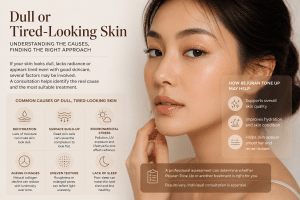
Some clients describe their skin as looking dull, tired or lacking in freshness even when there is no obvious pigmentation.
This can be influenced by several factors, including dehydration, surface texture, environmental exposure and normal changes in the skin over time.
A consultation can help determine whether the concern is primarily related to skin quality or whether another issue is making the complexion appear less bright.
Rejuran Tone Up may be one option discussed depending on the individual’s skin assessment and treatment goals.
Visible Pigmentation
Pigmentation is another common concern raised during consultations.
This may include:
- Freckles
- Sun-related brown spots
- Post-inflammatory pigmentation
- Patchy areas of darker skin
- General unevenness in complexion
It is important to understand that not all pigmentation is the same.
Different types of pigmentation can respond differently to cosmetic treatments. In some situations, light or laser-based treatments may be more appropriate to discuss.
A practitioner can assess the type, depth and distribution of visible pigmentation before recommending a treatment plan.
Post-Acne Marks
After acne settles, some people are left with visible red or brown marks that can make the skin tone look uneven.
These marks are different from acne scars that involve changes in skin texture.
During a Rejuran Tone Up consultation, the practitioner may assess whether the main concern is residual pigmentation, redness, textural scarring or a combination of these factors.
This helps determine whether Rejuran Tone Up should be considered on its own or whether another skin treatment may be more suitable.
Dry or Dehydrated-Looking Skin
Skin that lacks hydration can sometimes appear dull, rough or less even.
Clients may notice that makeup sits differently on the skin or that fine surface lines become more visible when the skin is dry.
During a consultation, the practitioner may look at overall hydration, skincare habits and skin barrier condition.
Home skincare may also form part of the discussion because clinic treatments are only one component of maintaining healthy-looking skin.
Changes in Skin Texture
Texture can strongly influence how even the skin looks.
Even when pigmentation is minimal, enlarged pores, roughness or irregular surface texture can reflect light unevenly and make the complexion appear less smooth.
A practitioner may assess concerns such as:
- Visible pores
- Mild roughness
- Uneven surface texture
- Post-acne textural changes
- General changes associated with ageing
Depending on what is found, other treatments such as microneedling, radiofrequency-based procedures or laser treatments may also be discussed.
Visible Redness
Redness may sometimes be mistaken for pigmentation or general uneven skin tone.
Some clients notice persistent redness around the cheeks, nose or central face, while others experience intermittent flushing.
There are several possible causes of redness, so it is important not to assume that a skin-brightening treatment is automatically appropriate.
During the consultation, the practitioner may assess whether the redness appears superficial, vascular or related to skin sensitivity.
Different technologies may be discussed depending on the presentation.
Early Changes in Skin Quality
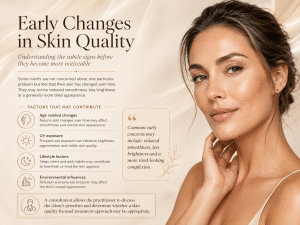
Some clients are not concerned about one particular problem but feel that their skin has changed over time.
They may notice reduced smoothness, less brightness or a generally more tired appearance.
These early changes may be influenced by age, UV exposure, lifestyle and environmental factors.
A consultation allows the practitioner to discuss the client’s priorities and determine whether a skin-quality focused treatment approach may be appropriate.
Sun-Related Skin Changes
Sydney’s high UV exposure means that sun-related skin changes are frequently discussed during cosmetic consultations.
Repeated sun exposure may contribute to visible freckles, brown spots, uneven pigmentation and changes in skin texture.
A practitioner may ask about previous sun exposure and current sunscreen habits as part of the consultation.
Sun protection is also important when considering any cosmetic treatment designed to improve the appearance of the skin.
Without ongoing UV protection, pigmentation and uneven tone may continue to become more noticeable over time.
Can Several Concerns Be Treated at the Same Time?
Many people have more than one concern.
For example, someone may have pigmentation, visible pores and dehydration at the same time.
This does not necessarily mean that every concern should be treated using the same procedure.
In some cases, the practitioner may discuss a staged treatment plan.
One concern may be prioritised first, followed by another treatment later. Alternatively, different treatments may be recommended at different intervals depending on the skin and individual goals.
The purpose of a consultation is to create a more personalised approach rather than selecting a treatment based only on a single symptom.
What Will Your Practitioner Assess?
During a Rejuran Tone Up consultation, your practitioner may look at:
- Skin tone and pigmentation pattern
- Areas of redness
- Skin texture
- Hydration
- Visible pores
- Previous acne or inflammation
- Previous cosmetic treatments
- Current skincare routine
- Sun exposure
- Skin sensitivity
- Relevant medical history
- Your main treatment goals
These factors help guide the treatment discussion and determine whether Rejuran Tone Up may be appropriate.
Individual suitability varies, and results cannot be guaranteed.
When Might Another Treatment Be Discussed?
Rejuran Tone Up is not automatically the best option for every concern.
If the main issue is visible pigmentation, the practitioner may discuss treatments such as IPL, DPL or another appropriate laser or light-based treatment.
If the concern is mainly texture, other options may be considered.
If persistent redness is the primary issue, a different treatment approach may be more suitable.
This is why an assessment is valuable before deciding which procedure to book.
Rejuran Tone Up Consultation in Sydney
If you are considering Rejuran Tone Up in Sydney, a professional consultation can help identify the concerns affecting your skin and clarify which treatment options may be suitable.
Sky Beauty Cosmetic Clinic offers personalised consultations at:
Sydney CBD Shop 1060A, World Square 644 George Street, Sydney NSW 2000
Macquarie Park Shop 2054, Level 2, Macquarie Centre Macquarie Park NSW 2113
Our practitioners can assess your skin, discuss your concerns and explain available treatment options based on your individual needs.
The goal of the consultation is not simply to recommend a particular procedure, but to help you understand what may be contributing to your skin concerns and which approach may be appropriate.
This article provides general information only and does not replace individual medical or healthcare advice. Treatment suitability, potential risks, expected outcomes and alternatives should be discussed with an appropriately qualified healthcare practitioner.