

Why Does the Skin Around the Eyes Require a Different Cosmetic Assessment?
The skin around the eyes is different from many other areas of the face. It is relatively thin, highly mobile and closely connected with underlying facial structures. These characteristics mean that concerns around the eyes often require a more individualised assessment before cosmetic treatment options are considered.
People searching for eye-area cosmetic consultations in Sydney may be interested in understanding fine lines, changes in skin texture, dark circles, puffiness, hollowness or general changes in the appearance of the under-eye area. Although these concerns may appear similar, they can have very different contributing factors.
At Sky Beauty Cosmetic Clinic in Sydney, our approach begins with a personalised consultation. Our experienced practitioners assess the eye area, listen to individual concerns and consider relevant cosmetic history before personalised recommendations are discussed.
Understanding why the eye area requires a different assessment can help you know what to expect when attending a cosmetic consultation.
Why Is the Skin Around the Eyes Different?
The skin surrounding the eyes has particular characteristics that distinguish it from other facial areas.
It is relatively thin and experiences frequent movement throughout the day. Blinking, smiling, squinting and other facial expressions continually affect the skin and surrounding tissues.
The appearance of the eye area can also be influenced by what lies beneath the skin.
Facial anatomy, underlying structures and the relationship between the lower eyelid and cheek can all influence how the area looks.
For this reason, an apparent skin concern may not necessarily involve the skin alone.
Why Does Skin Thickness Matter?
Skin thickness can influence how texture, colour and underlying structures appear.
Because the skin around the eyes is relatively delicate, certain changes may become more noticeable in this area than elsewhere on the face.
However, simply identifying that the skin looks different does not necessarily explain why.
A cosmetic assessment considers the visible characteristics of the skin together with the surrounding anatomy rather than assuming that every eye-area concern has the same cause.
Why Is Facial Movement Important?
The eye area is constantly moving.
During a consultation, your practitioner may observe the area while your face is relaxed and again when you smile or squint.
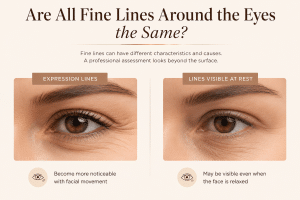
Some lines may become significantly more noticeable during facial expression, while others remain visible at rest.
This distinction can provide useful information about the characteristics of the concern.
It also explains why a photograph or selfie may not provide enough information for a complete assessment. Facial expression, lighting and camera angle can all change how the eye area appears.
Are All Fine Lines Around the Eyes the Same?
No.
“Fine lines” is a general description, but individual lines can have different characteristics.
Some may be closely associated with facial movement, while others may be visible when the face is relaxed. Changes in skin texture and other individual characteristics may also affect how noticeable they appear.
During an eye-area consultation in Sydney, the practitioner can assess where the lines appear, whether they change with facial expression and what other characteristics are present.
The presence of fine lines alone does not determine the most suitable way to understand or address individual concerns.
Why Do Dark Circles Need a Separate Assessment?
Dark circles are one of the most common concerns raised during eye-area consultations, but they can also be one of the most complex.
The appearance of darkness beneath the eyes may be influenced by pigmentation, skin characteristics, underlying vessels, facial anatomy, shadows or several factors occurring together.
For example, the shape of the under-eye area may create a shadow that becomes more noticeable under certain lighting conditions.
Another person may have visible colour differences that relate more directly to the skin.
Both people may describe having dark circles, but their concerns are not necessarily the same.
This is why an individual assessment is an important first step before considering cosmetic options.
Is Under-Eye Hollowness a Skin Concern?
Not necessarily.
The appearance of hollowness can be influenced by facial anatomy and the transition between the lower eyelid and cheek.
These structural characteristics may create shadows that affect how the under-eye area appears.
This differs from a concern involving primarily the visible texture or characteristics of the skin.
At Sky Beauty Cosmetic Clinic, our practitioners consider both the skin and surrounding facial anatomy when assessing an under-eye concern.
Understanding whether the concern appears to involve skin, structure or a combination of factors can help guide the cosmetic discussion.
What About Puffiness and Eye Bags?
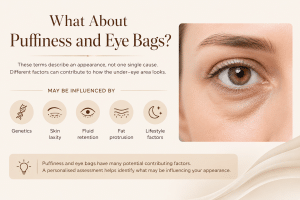
Puffiness and eye bags are also commonly mentioned during consultations.
However, these terms describe an appearance rather than one specific underlying cause.
Different individual and anatomical factors can influence how prominent the area beneath the eyes appears.
For this reason, puffiness should not automatically be grouped together with fine lines, texture changes or dark circles.
If puffiness is your primary concern, this should be discussed specifically during your consultation.
Can Several Concerns Be Present at the Same Time?
Yes.
Many people have more than one characteristic affecting the appearance of their eye area.
For example, someone may notice fine lines and changes in texture while also having pigmentation or structural shadowing.
When several factors occur together, focusing on only one characteristic may provide an incomplete understanding of the area.
A comprehensive assessment allows the practitioner to consider how different factors may be contributing to the overall appearance.
Why Is Previous Cosmetic Treatment History Important?
Previous cosmetic procedures may influence the assessment of the eye area.
Your practitioner may ask whether you have previously undergone cosmetic injectables, laser or light-based procedures, energy-based treatments or other cosmetic procedures involving the face.
Where possible, provide information about previous cosmetic services, areas involved and approximately when they were performed.
Even treatments performed several years earlier may be worth mentioning.
If you do not remember the exact product or procedure name, provide as much information as possible.
Does Your Skincare Routine Matter?
Your current skincare may also be relevant.
Products used around the eyes, recently introduced skincare ingredients and previous irritation or sensitivity may provide useful information about the current condition of the skin.
If you have noticed a sudden or unusual change around the eyes, tell your practitioner.
Not every concern around the eyes is necessarily cosmetic. In some circumstances, medical assessment may be appropriate before cosmetic treatment is considered.
Why Is Medical History Part of a Cosmetic Assessment?
A cosmetic consultation is not limited to looking at appearance.
Relevant medical conditions, medications, allergies and other individual circumstances may need to be considered before a cosmetic procedure is discussed.
Providing complete and accurate information helps your healthcare professional assess your individual circumstances.
If you are unsure whether something is relevant, mention it during the consultation so your practitioner can determine whether it needs to be considered.
Why Are Expectations Assessed?
Expectations are an important part of cosmetic treatment planning.
Social media, photographs and other people’s experiences can influence what someone expects from a particular procedure.
However, facial anatomy and skin characteristics vary considerably between individuals.
During your consultation, explain what concerns you and what you hope to address.
Your practitioner can then discuss what they observe during the assessment, what factors may be contributing to the appearance and what limitations may need to be considered.
Why Isn’t There One Treatment for Every Under-Eye Concern?
Different eye-area concerns can involve different factors, so there is no single cosmetic approach that is automatically suitable for everyone.
Cosmetic procedures can also differ significantly in how they work. Some approaches focus on skin characteristics, while others may involve different technologies, techniques or treatment objectives.
The appropriate discussion depends on what is identified during the individual assessment.
In some circumstances, one cosmetic approach may be considered. In others, a different option may be discussed, treatment may need to be delayed or cosmetic treatment may not be recommended.
What Should You Ask During Your Consultation?
An eye-area consultation should give you an opportunity to understand your concern rather than simply choose a treatment.
You may want to ask what factors appear to be contributing to the appearance of your eye area and why a particular cosmetic approach is being considered.
It is also useful to discuss potential risks, possible side effects, expected recovery, aftercare and alternative options.
You should understand what is being proposed before deciding whether you wish to proceed.
Eye-Area Cosmetic Assessment at Sky Beauty Cosmetic Clinic Sydney
For people researching eye-area cosmetic treatments in Sydney, understanding the characteristics of the area is an important first step before considering treatment.
Fine lines, texture changes, dark circles, puffiness and hollowness may appear similar between individuals but can involve different contributing factors. Skin characteristics, pigmentation, facial anatomy, shadows and facial movement may all influence the appearance of the eye area.
At Sky Beauty Cosmetic Clinic in Sydney, our experienced practitioners provide personalised consultations to assess the eye area, understand individual concerns and review relevant medical and cosmetic treatment history before appropriate options are discussed.
A professional eye-area assessment can help you better understand individual concerns and make a more informed decision about your cosmetic options.