

Nasolabial Folds Sydney CBD: What Should You Ask During a Cosmetic Consultation?

Nasolabial folds are the natural creases that extend from the sides of the nose toward the corners of the mouth. They are a normal part of facial anatomy, but their appearance can vary considerably between individuals.
Some people have noticeable nasolabial folds from a younger age, while others find that they gradually become more visible over time. Facial structure, skin characteristics, genetics, movement and changes in facial contours may all influence their appearance.
If you are researching Nasolabial Folds Sydney CBD or Smile Lines Sydney, a cosmetic consultation can be an opportunity to better understand your individual facial characteristics and discuss your concerns with a qualified practitioner.
Knowing what to ask during your consultation can also help you better understand your individual facial characteristics and the factors contributing to your concern.
What Factors Are Contributing to My Nasolabial Folds?
This is one of the most useful questions to ask.
Nasolabial folds do not necessarily develop for the same reason in everyone.
For one person, facial structure may be a significant factor. For another, skin characteristics or gradual changes in facial contours may contribute more strongly.
Often, several factors are involved at the same time.
Your practitioner may assess the relationship between your cheeks, mid-face and lower face to better understand the factors influencing the appearance of the folds.
Are My Nasolabial Folds Mainly Visible at Rest or During Movement?
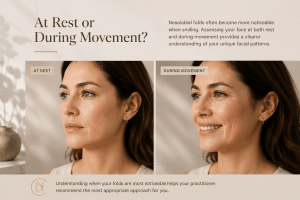
Nasolabial folds often become more noticeable when smiling.
This happens because movement of the cheeks changes the contours around the nose and mouth.
For some people, the folds become much less noticeable when the face is relaxed. For others, they remain relatively visible at rest.
Ask your practitioner to assess your face during both natural expression and relaxation.
This can provide more information than evaluating a single photograph or looking at the face in only one position.
Is My Facial Structure Influencing Their Appearance?
Facial anatomy can influence the appearance of nasolabial folds.
The shape and projection of the cheeks, overall facial proportions and the relationship between different areas of the face can all affect how prominent the folds appear.
Some people naturally have a stronger transition between the cheek and the area beside the mouth.
This can make the nasolabial folds appear more defined regardless of age.
Asking about your facial structure can therefore help you understand whether your concern is primarily related to the skin or involves broader facial characteristics.
Are My Cheeks or Mid-Face Affecting the Nasolabial Area?
The nasolabial fold does not exist in isolation.
The cheeks and mid-face are closely related to the area around the nose and mouth. Changes or natural differences in these areas may influence the appearance of the fold.
During your consultation, you can ask whether the surrounding facial contours are contributing to what you are seeing.
This encourages a broader assessment rather than focusing exclusively on the visible crease.
Is My Skin Quality Contributing to the Appearance?
Skin characteristics may also influence how facial folds appear.
During an assessment, a practitioner may consider factors such as skin texture, thickness, elasticity and overall condition.
However, visible nasolabial folds do not automatically indicate poor skin quality.
Someone can have relatively smooth skin and still have noticeable folds because of their underlying facial anatomy.
Ask your practitioner how skin characteristics and other facial structures may relate to the appearance you are noticing.
Why Does One Side Look Deeper Than the Other?
Facial asymmetry is normal.
The two sides of the face may differ slightly in cheek structure, facial movement and tissue distribution.
These differences can make one nasolabial fold appear more noticeable.
Lighting and camera angles can also exaggerate differences between the two sides.
If asymmetry is one of your concerns, ask your practitioner to explain what they observe rather than assuming that both sides of the face should look identical.
Have My Facial Contours Changed Over Time?
Many people become concerned about nasolabial folds because they notice that their face looks different from several years ago.
If this applies to you, mention it during your consultation.
Older photographs may sometimes provide useful context, although differences in lighting, expression and camera angle should always be considered.
Your practitioner can assess whether broader changes in facial contours may be influencing the appearance of the nasolabial area.
What Can I Reasonably Expect?
This is an important question during any cosmetic consultation.
Explain what you are noticing and what you would like to discuss rather than assuming that a particular approach is suitable for you.
Your practitioner can help you understand your individual facial characteristics and discuss what options may be appropriate.
A consultation should provide enough information for you to consider your options without feeling pressured to make an immediate decision.
What Are My Available Options?
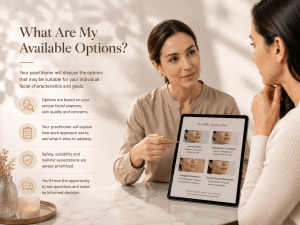
Rather than arriving at the consultation with a particular outcome in mind, consider asking your practitioner to explain the factors contributing to your concern. Your facial assessment, relevant history and personal circumstances can all help provide a better understanding of your individual situation.
What Are the Potential Risks?
If you are considering any cosmetic procedure following your consultation, understanding potential risks is essential.
Ask your practitioner to explain the risks and possible complications associated with any option being considered.
You may also want to ask whether there are factors in your medical history that could affect suitability.
Cosmetic procedures should be considered carefully, taking into account individual circumstances as well as appearance.
Who Will Be Responsible for My Care?
It is reasonable to ask who will assess you and who would be responsible for your care if you decide to proceed with a cosmetic procedure.
Depending on the procedure being considered, different professional qualifications and clinical requirements may apply.
You can ask about the practitioner’s qualifications, training and experience relevant to the procedure being discussed.
You should also understand who you can contact if you have questions after a procedure.
What Information About My Medical History Should I Provide?
Providing an accurate medical and cosmetic history is an important part of the consultation.
Tell your practitioner about relevant health conditions, medications, allergies and previous cosmetic procedures.
If you have previously had procedures involving the same area, provide as much information as you reasonably can, including when they were performed.
This information can help the practitioner assess your individual circumstances more appropriately.
What Should I Know About Aftercare and Follow-Up?
If a cosmetic procedure is being considered, ask what aftercare and follow-up would be involved.
Questions may include:
- What should I expect after the procedure?
- Are there activities I may need to avoid?
- What signs or symptoms should prompt me to contact the clinic?
- Who should I contact if I have concerns?
- Is follow-up normally recommended?
Understanding aftercare before making a decision can help you know what the overall process involves.
Do I Need to Decide During the Consultation?
A consultation is an opportunity to gather information.
You should feel comfortable asking questions and taking time to consider what has been discussed.
If you are uncertain about anything, ask the practitioner to explain it again.
Making an informed decision is more important than feeling that you need to proceed immediately.
What Should a Nasolabial Fold Assessment Include?
A comprehensive assessment may look beyond the nasolabial fold itself.
Depending on the individual, your practitioner may consider:
- Facial structure and proportions
- Cheek and mid-face contours
- Skin characteristics
- Facial symmetry
- Appearance at rest and during expression
- Changes in facial contours over time
- Relevant medical history
- Previous cosmetic procedures
- Your individual concerns and expectations
These factors can help provide a more complete understanding of the characteristics influencing the appearance of your nasolabial folds.
Why Is an Individual Consultation Important?
Online information can help you understand general facial anatomy, but it cannot determine what is contributing to your individual concern.
Two people may have similar-looking nasolabial folds for different reasons.
One person’s appearance may be influenced mainly by natural facial structure, while another person’s may involve a combination of skin characteristics, facial contours and changes over time.
An individual assessment allows these factors to be considered together.
Nasolabial Folds Sydney CBD: Preparing for Your Consultation
If you are researching Nasolabial Folds Sydney CBD or Smile Lines Sydney, preparing a few questions before your appointment can help you get more from your consultation.
Ask about the factors contributing to your concern, your facial anatomy, skin characteristics, available options, potential risks, practitioner qualifications and what follow-up may be involved.
Most importantly, a cosmetic consultation should help you understand your individual circumstances rather than assume that one approach is appropriate for everyone.
At Sky Beauty Cosmetic Clinic in Sydney CBD, our approach begins with an individual consultation and facial assessment. Our practitioners consider your facial characteristics, skin condition, relevant history and personal concerns to help you better understand the factors that may influence the appearance of your nasolabial folds.
If you are concerned about nasolabial folds or smile lines, a consultation at Sky Beauty Cosmetic Clinic provides an opportunity to ask questions, better understand your facial characteristics and make an informed decision about your next steps.