

Nasolabial Folds Macquarie Park: What Can You Expect During a Facial Assessment?
Nasolabial folds are the natural creases that extend from the sides of the nose toward the corners of the mouth. Sometimes referred to as smile lines, they are a normal part of facial anatomy and can be visible at different ages.
For some people, these folds are mainly noticeable when smiling. Others may find that they gradually become more visible when the face is relaxed. Facial structure, cheek contours, skin characteristics, genetics, movement and natural changes over time can all influence their appearance.
If you are researching Nasolabial Folds Macquarie Park or Smile Lines Sydney, a facial assessment can help you better understand the individual factors that may influence what you see.
Rather than focusing only on the visible fold, a professional assessment usually considers the relationship between different areas of the face.
What Is a Facial Assessment?
A facial assessment is an opportunity for a practitioner to examine your individual facial characteristics and discuss the concerns you have noticed.
The purpose is not simply to identify a line or fold.
Instead, the practitioner may look at your overall facial proportions, skin characteristics, symmetry, movement and the relationship between the cheeks, mid-face and lower face.
This broader approach can provide useful context because similar-looking nasolabial folds may have different contributing factors in different people.
What Will Your Practitioner Ask?
Your consultation will usually begin with a conversation.
Your practitioner may ask what you have noticed about your nasolabial folds and whether their appearance has changed over time.
You may be asked whether the folds concern you mainly when smiling, when your face is relaxed or in photographs.
Your personal goals are also important. Explaining what specifically concerns you can help the practitioner understand what you would like to discuss during the assessment.
Will Your Facial Structure Be Assessed?
Facial structure can influence the appearance of nasolabial folds.
Everyone has different facial proportions and underlying anatomy.
The shape and projection of the cheeks, the relationship between the mid-face and lower face, and the natural contours around the mouth can all influence how prominent nasolabial folds appear.
Some people naturally have relatively defined folds from a younger age because of their facial structure.
This is why visible nasolabial folds should not automatically be considered a sign of a particular skin problem or premature ageing.
Why Are the Cheeks and Mid-Face Examined?
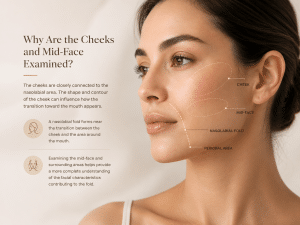
The cheeks are closely connected to the nasolabial area.
A nasolabial fold forms near the transition between the cheek and the area around the mouth. The shape and contour of the cheek can therefore influence how this transition appears.
During a Nasolabial Folds Macquarie Park assessment, your practitioner may examine the mid-face as well as the fold itself.
Looking at the surrounding areas can help provide a more complete understanding of the facial characteristics associated with the fold.
Will Your Skin Be Assessed?
Skin characteristics are another part of the overall picture.
Your practitioner may observe the texture, thickness, elasticity and general condition of the skin around the cheeks and lower face.
Natural changes in these characteristics can influence how facial lines and folds appear over time.
However, a noticeable nasolabial fold is not necessarily caused by the skin alone.
Someone may have relatively smooth skin but still have prominent folds because of their facial anatomy and contours.
Will Your Face Be Assessed While You Smile?
Yes, facial movement can provide useful information.
Nasolabial folds often become more noticeable during smiling because the cheeks and surrounding tissues move.
Your practitioner may therefore assess your face both at rest and during natural expressions.
For some people, the folds are primarily visible during movement. For others, they remain noticeable when the face is relaxed.
Observing both situations helps provide a more complete picture of your facial characteristics.
Is Facial Symmetry Considered?
Natural facial asymmetry is extremely common.
One cheek may have a slightly different shape or projection from the other. Facial movement may also differ between the two sides.
As a result, one nasolabial fold may appear deeper, longer or more noticeable.
An assessment may consider these differences rather than assuming that both sides of the face should look exactly the same.
Will Age Be Considered?
Age can provide context, but it is only one part of a facial assessment.
Nasolabial folds can be visible in both younger and older adults.
Some younger people naturally have defined smile lines because of genetics or facial structure, while other people may notice their folds becoming more prominent gradually over time.
For this reason, an individual assessment should consider the person’s facial characteristics rather than making assumptions based on age alone.
Can Changes in Facial Contours Be Assessed?
Facial contours can change throughout adulthood.
These changes may affect the relationship between the cheeks, mid-face and lower face.
When the transition between these areas becomes more defined, existing nasolabial folds may also appear more noticeable.
If you feel your facial appearance has changed over time, tell your practitioner during the consultation.
Older photographs may sometimes provide additional context, although differences in lighting, expression and camera angle should always be taken into consideration.
Will Previous Cosmetic Procedures Be Discussed?
Your practitioner may ask whether you have previously had cosmetic procedures involving the face.
Providing an accurate history can be important when assessing your current facial characteristics.
You may be asked approximately when previous procedures occurred and which areas were involved.
Relevant medical history, medications and other individual considerations may also be discussed where appropriate.
Why Are Your Personal Concerns Important?

Two people can have similar-looking nasolabial folds but feel very differently about them.
One person may mainly notice the folds in photographs, while another may be concerned about their appearance when the face is relaxed.
Your practitioner needs to understand what you are actually noticing rather than making assumptions based only on facial appearance.
A consultation should therefore include a discussion of your concerns and expectations as well as the physical assessment.
Are Photographs Useful During a Facial Assessment?
Photographs can sometimes provide useful context, particularly when you are trying to understand changes that have occurred over several years.
However, photographs have limitations.
Camera angle, lighting, facial expression and lens distance can significantly affect how deep nasolabial folds appear.
Strong side or overhead lighting may create shadows that make the folds look more prominent.
An in-person facial assessment allows the practitioner to view the face from multiple angles and during natural movement.
Why Is a Whole-Face Approach Important?
Nasolabial folds are part of a larger facial structure.
Focusing exclusively on the crease may not explain why it appears prominent.
A facial assessment may consider:
- Overall facial proportions
- Cheek and mid-face contours
- Skin characteristics
- Facial symmetry
- Appearance at rest
- Appearance during smiling and other expressions
- Natural changes in facial contours
- Relevant medical and cosmetic history
- Your individual concerns and expectations
Considering these factors together can provide a better understanding of your individual facial characteristics.
What Questions Can You Ask During Your Assessment?
Your consultation is also an opportunity to ask questions.
You may want to ask:
- What factors are contributing to the appearance of my nasolabial folds?
- Is my facial structure influencing their appearance?
- Are my cheeks or mid-face contributing to what I see?
- Why is one side more noticeable than the other?
- Are my folds mainly visible during movement or also at rest?
- What role do my skin characteristics play?
- Have my facial contours changed over time?
- What should I understand about my individual facial characteristics?
There is no need to arrive at your consultation already knowing the answers.
The purpose of the assessment is to help you better understand your individual facial characteristics.
Does a Consultation Mean You Need to Proceed With Anything?
No. A facial assessment is an opportunity to obtain information and discuss your concerns.
You can ask questions, consider the information provided and take time to decide what you would like to do next.
Any discussion during your consultation should take into account your individual facial characteristics, concerns, relevant history and circumstances.
Nasolabial Folds Macquarie Park: Why Individual Assessment Matters
Nasolabial folds are normal facial features, and there is no single reason why they may appear more noticeable in one person than another.
Facial structure, cheek contours, skin characteristics, genetics, movement, symmetry and natural changes over time can all contribute.
For people researching Nasolabial Folds Macquarie Park or Smile Lines Sydney, a professional facial assessment can provide a more individual understanding of these factors rather than focusing only on the visible crease.
At Sky Beauty Cosmetic Clinic in Macquarie Park, our approach begins with an individual consultation and facial assessment. Our practitioners consider your facial characteristics, skin condition, movement, symmetry, relevant history and personal concerns to help you better understand the factors that may influence the appearance of your nasolabial folds.
If you would like to better understand the appearance of your nasolabial folds or smile lines, a consultation at Sky Beauty Cosmetic Clinic Macquarie Park provides an opportunity to discuss your concerns and receive an individual facial assessment.