

What Is the Relationship Between the Nasal Base, Upper Lip and Mid-Face?
When people assess facial balance, they often look at individual features such as the nose, lips or cheeks. However, these areas do not exist independently. The way one feature appears can be strongly influenced by the structures around it.
A good example is the relationship between the nasal base, upper lip and mid-face.
These three areas sit close together in the centre of the face, and differences in projection, structure and soft tissue support can change how each feature is perceived.
For people researching Nasal Base Sydney or considering a Nasal Base Assessment Sydney, understanding these relationships can provide a clearer picture of why the central face looks different from one person to another.
At Sky Beauty Cosmetic Clinic, our facial assessments consider overall facial proportions rather than looking at the nasal base as an isolated feature.
What Is the Nasal Base?
The nasal base generally refers to the lower supporting region of the nose and the surrounding area where the nose connects with the central face.
It sits directly above the upper lip and between the central portions of the cheeks.
Some people naturally have stronger forward projection through this area, while others have a flatter or slightly recessed appearance.
This difference can influence how the nose, upper lip and surrounding mid-face look from both the front and side.
A flatter nasal base does not necessarily represent a problem. It can simply be part of someone’s natural facial anatomy.
How Is the Nasal Base Connected to the Mid-Face?
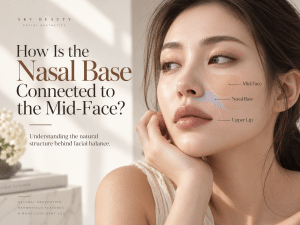
The mid-face includes the central facial structures around the cheeks, nose and areas beneath the eyes.
Underlying bone structure and surrounding soft tissues help determine how projected or flat this region appears.
If someone naturally has stronger mid-face projection, the transition between the cheeks and nasal base may appear different from someone with a flatter central facial structure.
When the mid-face has less forward projection, the nasal base may also appear relatively recessed.
This can affect the overall appearance of the centre of the face, particularly when viewed from a 45 degree angle or side profile.
How Does the Nasal Base Influence the Upper Lip?
The nasal base sits immediately above the upper lip, so these two areas have an important visual relationship.
From the side, the amount of projection around the nasal base can affect how the upper lip appears in comparison with the nose.
For example, a relatively recessed nasal base may create a stronger transition between the nose and upper lip. Depending on the person’s natural anatomy, this can make the nose appear more projected or change how the upper lip is perceived within the profile.
However, upper lip appearance is also influenced by lip volume, dental structure, jaw position and other anatomical factors.
This is why the relationship needs to be considered as part of the entire face.
Can a Flat Nasal Base Make the Mid-Face Look Flatter?
In some people, yes.
A flatter nasal base may contribute to an overall impression of reduced projection through the central face.
However, it is important to distinguish between the nasal base itself and the surrounding mid-face.
Someone may believe that their nasal base is the main concern when cheek projection or underlying facial structure is also contributing to the appearance.
During a consultation at Sky Beauty Cosmetic Clinic Sydney, the practitioner may therefore assess several connected areas rather than focusing only on the point beside the nose.
Can the Upper Lip Affect How the Nasal Base Looks?
Yes. The relationship works in both directions.
A naturally more projected upper lip may make the area above it appear relatively recessed, while a less projected upper lip can create a different balance between the nose and central face.
The position of the teeth and jaws can also influence the side profile.
This demonstrates why facial assessment is based on relationships rather than individual measurements.
A feature can look different depending on what sits above, below and beside it.
What About the Nasolabial Folds?
The nasolabial folds begin near the sides of the nose and extend toward the corners of the mouth.
Because they are located close to the nasal base, their appearance can sometimes influence how people perceive this area.
A shadow near the upper part of the nasolabial fold may make the nasal base appear more recessed.
Likewise, differences in nasal base and mid-face projection may influence the shadows around the beginning of the fold.
However, nasolabial folds are complex. Their appearance can also be influenced by cheek structure, soft tissue distribution, skin characteristics, facial movement and natural ageing.
For this reason, a visible fold should not automatically be assumed to be a nasal base issue.
Why Does This Relationship Matter From the Side?

The side profile makes differences in facial projection particularly visible.
From this angle, the practitioner can assess how the nose transitions into the nasal base, how the nasal base relates to the upper lip and how these structures sit within the overall mid-face.
The chin is also important.
For example, a relatively recessed chin may make the nose appear more prominent. Similarly, a flatter nasal base or mid-face may increase the visual contrast between the nose and surrounding structures.
This is why profile balance cannot be accurately assessed by looking at one feature alone.
Why Can These Areas Look Different in Photos?
Many people become aware of their nasal base after seeing themselves in photographs or videos.
However, camera angle, lens distance and lighting can significantly influence facial proportions.
Strong lighting can create shadows beside the nose and around the nasolabial folds, making the central face appear more recessed.
Close selfies may exaggerate the projection of the nose compared with the cheeks and lips.
At Sky Beauty Cosmetic Clinic, facial assessment considers the face from multiple angles rather than relying on a single photograph.
Does Age Change the Relationship Between These Areas?
Age related changes can affect the appearance of the nasal base, upper lip and mid-face.
Over time, changes in skin elasticity, facial volume distribution and soft tissue support can alter facial contours.
The cheeks may appear less supported, nasolabial folds may become more noticeable and the transition between the nose and surrounding tissues may change.
Someone who has always had a relatively flat nasal base may therefore notice it more as they get older.
The underlying structure may not have dramatically changed. Instead, changes in the surrounding tissues may make existing anatomical characteristics more visible.
What Is Evaluated During a Nasal Base Assessment?
During a Nasal Base Assessment Sydney, the practitioner may examine the face from the front, side and 45 degree angles.
Assessment may include:
- Nasal base projection
- Nose shape and projection
- Mid-face structure
- Cheek projection
- Upper lip position
- Nasolabial folds
- Chin projection
- Facial symmetry
- Soft tissue characteristics
- Overall facial proportions
Previous cosmetic procedures and individual concerns may also be discussed.
The purpose is to identify which structures are actually contributing to the appearance that concerns you.
Does a Recessed Nasal Base Always Need Treatment?
No.
A flatter or more recessed nasal base can be a completely normal anatomical characteristic.
There is no universal amount of projection that every face should have.
For some people, a flatter nasal base works naturally with their nose, lips and overall facial proportions. For others, the relationship between these areas may be something they would like professionally assessed.
A consultation should therefore focus on understanding individual anatomy before discussing whether any cosmetic option is appropriate.
Why Is Full Facial Assessment Important?
If someone focuses only on the nasal base, they may overlook the reason the area appears recessed.
The mid-face, cheeks, upper lip, nose and chin can all change how the nasal base is visually perceived.
At Sky Beauty Cosmetic Clinic Sydney CBD and Macquarie Park, facial assessments consider these relationships as part of the overall face.
The goal is not to create identical proportions for every person. It is to understand how individual facial structures work together and what may be contributing to a specific concern.
If you are researching Nasal Base Sydney, understanding the connection between the nasal base, upper lip and mid-face is an important starting point.
Because when it comes to facial balance, one small area rarely tells the whole story.