

Nasal Base, Upper Lip, and Mid-Face Relationship

A refined facial result is rarely about one feature alone. When clients ask, “What Is the Relationship Between the Nasal Base, Upper Lip and Mid-Face?” they are often noticing a subtle change in overall harmony: the nose may seem wider, the upper lip less defined, or the cheeks less supported than before. These areas are closely connected by anatomy, movement, and the natural aging process.
Treatment planning looks beyond isolated lines or volume loss. It considers how the central face works as one balanced unit while taking natural facial expression into account.
The Relationship Between the Nasal Base, Upper Lip, and Mid-Face
The nasal base is the lower portion of the nose where the nostrils, alar creases, and central nose meet the upper lip. Directly beneath it sits the philtrum, the vertical area between the nose and upper lip. Above and beside these structures is the mid-face, including the cheeks, the area beside the nose, and the tissues that support the lower eyelid and smile lines.
These features share soft-tissue attachments and structural support from the upper jaw. The mid-face provides a foundation for the area around the nose and mouth. When cheek volume and support are well balanced, the transition from the lower eyelid to cheek, cheek to nose, and nose to upper lip tends to appear smooth and proportionate.
The upper lip is also influenced by the nasal base. Its shape, projection, and visible length are affected by the position of the nose, the angle between the nose and lip, dental and skeletal support, and the quality of the surrounding skin. That is why treating the lip without assessing the nose and mid-face can sometimes create a result that feels disconnected from the rest of the face.
Why Small Changes Can Affect Facial Balance
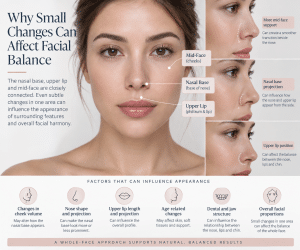
Facial aging is not simply a skin concern. Over time, the mid-face can lose volume and descend slightly, while bone and soft-tissue support gradually change. This may deepen the folds beside the nose, flatten the cheek, lengthen the appearance of the upper lip, or make the nasal base look more prominent.
Not every line near the nose necessarily needs to be treated directly. In some cases, the relationship between cheek support and the surrounding facial structures may influence the overall transition. In others, skin quality, lip hydration, muscle activity, or structural asymmetry may be the stronger influence. The right approach depends on the face in motion, not only on a still image.
Expression Matters as Much as Anatomy
The nose, upper lip, and mid-face move together when you smile, speak, laugh, or purse the lips. Strong movement around the upper lip can alter the way the lip rolls inward or reveals the teeth. Movement beside the nose may emphasize creases that are barely visible at rest.
This is why a thoughtful aesthetic assessment includes facial expression. A result can look polished in a photograph yet feel unnatural if it does not respect the way the face moves. Precision matters most in this central facial zone because even modest changes are highly visible.
How Personalized Treatment Planning Supports the Central Face
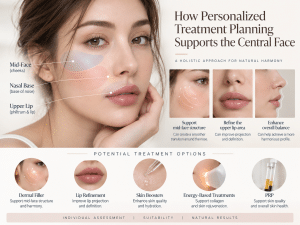
Non-surgical options may be discussed when the concern relates to volume distribution, skin quality, hydration, or fine lines. Depending on individual anatomy and goals, a clinician may discuss carefully placed dermal filler for mid-face or lip refinement, skin boosters for hydration and texture, regenerative options such as PRP, or energy-based treatments.
These treatments do not replace surgical correction where there is a significant structural concern with the nose, jaw, teeth, or lip position. They can, however, enhance proportion and soften age-related changes when selected conservatively and performed with a clear understanding of facial anatomy.
At Sky Beauty Cosmetic Clinic, personalized aesthetic care begins with evaluating proportion rather than promoting a single treatment. The aim is not to make the lips larger or the cheeks more pronounced. It is to create a balanced relationship between the central facial features, with results that look rested, refined, and unmistakably your own.
When a Conservative Approach Is Best
The central face can be overtreated easily. Excess product near the nasal base, upper lip, or smile lines may add heaviness, alter natural movement, or create an artificial look. For many clients, a staged plan with small, considered adjustments provides the most sophisticated outcome.
A qualified medical consultation should also review previous filler, allergies, medical history, dental changes, and any history of facial surgery. This helps determine whether treatment is appropriate and which option is most likely to support timeless confidence without compromising safety.
A considered approach looks at the nasal base, upper lip, and mid-face as connected features – then focuses on the areas that may require attention.