

What Skin Concerns Can IPL Treatment Target?
IPL is one of the most established light-based technologies used in cosmetic skin treatments. Yet many people are still unsure what it actually does.
Is IPL mainly for pigmentation? Can it help facial redness? What about sun damage, freckles, acne marks or signs of ageing?
For people researching IPL treatment in Sydney, the answer depends on the individual skin concern. IPL is a versatile technology, but it is not designed to treat every skin problem.
Understanding what IPL targets can help you decide whether it may be worth discussing during a professional skin consultation.
What Is IPL?
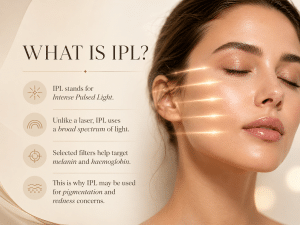
IPL stands for Intense Pulsed Light.
Unlike a laser, which typically uses a specific wavelength of light, IPL produces a broader spectrum of light. Filters and treatment parameters can then be selected according to the intended target within the skin.
Two important targets, or chromophores, are melanin and haemoglobin.
Melanin contributes to brown pigmentation, while haemoglobin is associated with blood vessels and redness.
This helps explain why the same general technology may be used for both pigmented and vascular concerns.
Can IPL Help With Sun Spots?
Sun spots are one of the better known cosmetic applications of IPL.
Repeated UV exposure can contribute to areas of excess pigmentation, particularly across frequently exposed areas such as the cheeks, forehead, temples and hands.
These flat brown areas are often referred to as sun spots or solar lentigines.
When suitable pigmentation absorbs IPL energy, the appearance of the targeted pigmentation may gradually become less noticeable.
Research reviews support IPL’s use for lentigines, hyperpigmentation and other visible features of photodamage.
What About Freckles?
Freckles may also be considered when discussing IPL.
Like other brown pigmentation, freckles contain melanin, which can interact with selected wavelengths of light.
Some people seek treatment because freckles have become more noticeable after years of sun exposure or because scattered pigmentation is making the complexion appear uneven.
However, freckles can return or become more noticeable again with further UV exposure.
Sun protection therefore remains important even after cosmetic pigmentation treatment.
Can IPL Improve Uneven Skin Tone?
“Uneven skin tone” can describe several different concerns.
For one person, it may mean scattered brown pigmentation.
For another, it may be a mixture of freckles, sun spots and redness.
IPL can be useful in skin rejuvenation because it can be adjusted to target selected pigmentary and vascular concerns. A systematic review of 16 studies involving 637 participants found reported improvements across concerns including hyperpigmentation, lentigines, erythema, telangiectasia and overall photoageing measures, although study quality and treatment protocols varied.
The aim is not to change your natural skin colour. It is to address suitable areas of visible colour irregularity.
Can IPL Target Facial Redness?
Pigmentation is only one side of IPL treatment.
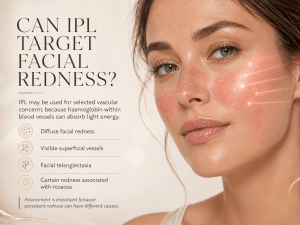
IPL may also be considered for selected vascular concerns because haemoglobin within blood vessels can interact with light energy.
Depending on the individual concern, IPL may be discussed for:
- Diffuse facial redness
- Visible superficial vessels
- Facial telangiectasia
- Certain redness-prone skin concerns
- Some vascular related colour changes
IPL has a long history of use for vascular lesions, and research reviews support its role in treating concerns such as telangiectasia and selected vascular conditions.
However, persistent facial redness can have different causes, so assessment should come before treatment.
Can IPL Help With Redness Around the Nose?
Small visible vessels around the nose are a common cosmetic concern.
Because vascular IPL treatments are designed around the absorption of light by haemoglobin, selected superficial vessels may be appropriate targets.
However, vessel size, depth, skin type and the cause of the redness can all influence treatment selection.
Some vascular concerns may be better suited to another light or laser technology.
This is why it is more useful to have the area assessed than to assume IPL will be the best option for every visible vessel.
Can IPL Help With Post Acne Marks?
After acne settles, it can leave colour behind.
These marks may be red, brown or a combination of both.
Flat brown marks may represent post inflammatory hyperpigmentation, while persistent red areas can have a vascular component.
Because IPL can target both melanin and haemoglobin using appropriate parameters, selected post acne colour changes may be discussed during consultation. IPL has also been studied for active acne, although acne is a complex condition and light treatment is not appropriate for every person.
Importantly, post acne colour is different from true acne scarring.
Can IPL Treat Acne Scars?
This depends on what you mean by “scar”.
If you are referring to flat red or brown marks left after acne, IPL may sometimes be relevant.
If you have indented scars such as rolling, boxcar or ice pick scars, IPL is generally not the primary technology used to address the structural appearance of those scars.
Textural acne scarring may require a different treatment approach.
This distinction is important because a treatment that improves colour does not necessarily correct deeper changes in skin structure.
What About Sun Damaged Skin?
IPL is frequently associated with photorejuvenation, meaning treatment of visible skin changes related to cumulative sun exposure.
Photodamaged skin may show several concerns simultaneously, including brown pigmentation, freckles, redness and uneven colour.
IPL can be useful in this situation because its adjustable wavelength spectrum allows different chromophores to be targeted.
Australian radiation safety guidance describes IPL as being used for superficial cosmetic concerns including pigmentation, skin redness, sun induced blemishes and photorejuvenation.
Can IPL Improve Fine Lines and Skin Texture?
IPL is sometimes discussed as a general skin rejuvenation treatment, but expectations are important.
Research has reported improvements in some measures of fine lines, texture and photoageing following IPL treatment.
However, IPL should not be confused with technologies specifically designed for significant skin tightening, deep resurfacing or structural facial rejuvenation.
If your main concern is substantial skin laxity, deep wrinkles or acne scar texture, another treatment category may be more appropriate.
Can IPL Treat Melasma?
Melasma requires a more cautious approach.
Although it appears as brown pigmentation, melasma is a complex condition influenced by multiple factors, including UV exposure, hormones and genetics.
IPL has been studied for melasma, but that does not mean it is automatically appropriate for everyone with the condition. Evidence reviews have found clinical evidence for its use, while treatment selection remains dependent on the individual presentation.
If pigmentation appears patchy or symmetrical, or you have previously been diagnosed with melasma, mention this during your consultation.
Is IPL Suitable for Every Skin Tone?
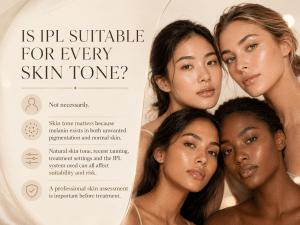
Not necessarily.
Skin colour is an important consideration because melanin exists both within unwanted pigmentation and normal skin.
This means the surrounding skin can also absorb light energy.
The person’s natural skin tone, recent tanning, treatment parameters and the specific IPL system being used can all influence suitability and risk.
ARPANSA notes that outcomes and risks from cosmetic light based procedures depend significantly on physical characteristics including skin colour.
A skin assessment is therefore particularly important before IPL.
What Can’t IPL Do?
The versatility of IPL sometimes leads people to expect it to address every sign of ageing.
It is not designed to.
IPL is primarily a light based treatment for suitable superficial pigmentary, vascular and photodamage related concerns.
If the main problem is significant facial sagging, volume loss, deep wrinkles, deep acne scars or other structural changes, another treatment approach may be required.
Sometimes several concerns exist at the same time, which is why a broader skin treatment plan may be discussed.
How Many IPL Sessions May Be Needed?
There is no universal number.
The number of sessions depends on what is being treated, the extent of the concern, skin type, individual response and treatment settings.
A systematic review of IPL skin rejuvenation studies reported treatment courses ranging from several sessions depending on the study and treatment approach. This does not mean that every person requires that number.
Your skin should be assessed individually and reviewed as treatment progresses.
IPL Treatment in Sydney: Why Consultation Comes First
IPL can target a surprisingly broad range of visible skin concerns, but its versatility is also why appropriate treatment selection matters.
If you are considering IPL treatment in Sydney, a professional consultation can help determine whether your main concern involves pigmentation, vascular redness, photodamage, post acne colour changes or something that may be better addressed with another technology.
Rather than beginning with:
“I want IPL.”
A more useful starting point is:
“What is causing the change I can see in my skin?”
Once the concern has been properly identified, your practitioner can discuss whether IPL may be an appropriate option.
Because good skin treatment is not about matching every client to the same device.
It is about matching the right technology to the right skin concern.