

Jawline Tightening and Skin Quality: What Is the Connection?
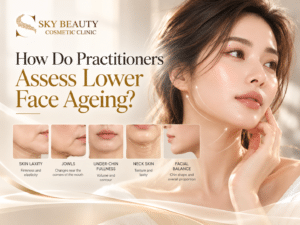
Jawline definition is influenced by bone structure, facial fat, muscle activity and the neck profile. However, the quality of the skin covering these deeper structures also affects how firm and defined the lower face appears.
Thin, dry or sun-damaged skin may make early laxity and fine lines more noticeable. Skin with better elasticity may sit more smoothly over the jawline, although good skin quality cannot prevent every age-related change.
At Sky Beauty Cosmetic Clinic Sydney CBD and Macquarie Park, skin quality is assessed together with the deeper structures of the lower face before treatment options are discussed.
What Does Skin Quality Mean?
Skin quality is a broad term that may include:
• Firmness • Elasticity • Hydration • Texture • Thickness • Pigmentation • Fine lines • Pore appearance • Sun-related changes • Overall skin condition
A person may have a structurally defined jaw but still be concerned about crepey or uneven skin. Another person may have smooth skin but reduced definition caused by facial fat or bone structure.
How Does Collagen Support the Jawline?
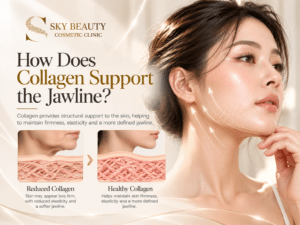
Collagen helps provide structure and firmness to the skin. Elastin allows the skin to stretch and return towards its original position.
Production of these proteins gradually declines with age. Existing fibres may also become less organised or damaged through cumulative sun exposure and other factors.
Around the jawline, this may contribute to:
• Reduced firmness • Mild skin laxity • Fine lines • Crepey texture • Early jowling • Less visible separation between the face and neck
Collagen loss is only one factor in jawline ageing, but it can influence how clearly the facial outline is seen.
Can Dry Skin Make Laxity Look Worse?
Dry or dehydrated skin may make fine lines, roughness and crepey texture more visible.
Improving hydration can help the skin look smoother and healthier, but it does not reposition descended facial tissue or remove loose skin. Hydration and tightening should not be treated as the same outcome.
The practitioner should explain whether a proposed treatment is intended to improve hydration, texture, firmness or a combination of these concerns.
How Does Sun Damage Affect Jawline Skin?
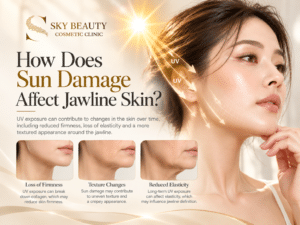
Repeated ultraviolet exposure can damage collagen and elastin. It may also contribute to pigmentation, rough texture and uneven skin tone.
The jawline and neck may receive less consistent sun protection than the central face. In Australia, cumulative sun exposure can be an important contributor to visible lower-face ageing.
Regular sun protection may help reduce further ultraviolet damage, but it cannot reverse every existing change.
Does Skin Thickness Matter?
Skin thickness varies between individuals and across different areas of the face.
Thinner skin may show fine lines, shadows and crepey texture more easily. Thicker skin may conceal some textural changes but can still develop laxity.
Skin thickness may also influence which treatments and settings are appropriate. A plan used for one person should not automatically be applied to another.
Is Skin Laxity the Same as Jowling?
Not exactly.
Skin laxity refers to reduced firmness and elasticity. Jowls may involve several layers, including:
• Loose skin • Descending facial fat • Changes in supportive ligaments • Reduced cheek support • Age-related bone changes • Muscle activity
A treatment focused only on skin quality may provide limited improvement when deeper tissue descent is the main concern.
Can Improving Skin Quality Sharpen the Jawline?
Improving skin firmness or texture may make the jawline appear smoother or more defined in suitable clients.
However, the degree of change depends on what is reducing definition. Skin-focused treatment may have limited effect when the main concern is:
• Significant under-chin fullness • Strong chewing muscles • Limited chin projection • Natural jawbone shape • Pronounced jowls • Substantial neck laxity
The possible benefit should be explained in relation to the individual anatomy.
What Skin Concerns May Be Assessed?
During a jawline consultation, the practitioner may examine:
• Skin thickness • Elasticity • Hydration • Fine lines • Crepey texture • Pigmentation • Sun damage • Scarring • Active irritation • Degree of laxity • Differences between the two sides
The skin may be observed at rest and during facial or neck movement.
What Other Structures Should Be Assessed?
Skin quality should not be evaluated in isolation.
A complete lower-face assessment may also consider:
• Facial fat distribution • Jowls • Under-chin fullness • Jawbone shape • Chin projection • Chewing muscles • Neck muscle activity • Facial symmetry • Jaw-to-neck angle • Previous cosmetic procedures
These factors help determine whether improving skin quality is likely to address the client’s main concern.
Depending on the assessment, discussions may include:
• Energy-based skin-firming procedures • Treatments intended to support hydration and texture • Options for localised under-chin fullness • Approaches addressing muscle activity • Treatments considering facial balance and structural support • Surgical referral for significant laxity • Skincare and sun protection • No treatment
Each option should have a clear purpose and realistic limitations.
Can Skincare Improve Jawline Skin Quality?
Skincare may support hydration, surface texture and protection from environmental damage.
A routine may include products selected for:
• Cleansing • Moisturising • Sun protection • Supporting skin renewal • Managing pigmentation or texture
However, topical products cannot remove excess skin, reposition facial fat or change the jawbone. Skincare should not be presented as an alternative to procedures when deeper tissue changes are present.
Who May Be Suitable for Skin-Focused Treatment?
Skin-focused treatment may be considered when:
• Laxity is mild to moderate • Texture or crepey skin is a main concern • The client understands that changes may be gradual • Expectations are realistic • Medical history is appropriate for the proposed treatment • Preparation and aftercare instructions can be followed
Suitability cannot be determined by age alone.
What Results May Be Realistic?
Results may be influenced by:
• Initial skin quality • Degree of laxity • Skin thickness • Age and genetics • Sun exposure • Smoking • Weight changes • Treatment selected • Previous procedures • Individual healing or collagen response
Non-surgical treatment cannot remove substantial excess skin or reproduce the result of a surgical facelift or neck lift.
A specific degree of tightening or jawline definition cannot be guaranteed.
Questions to Ask During a Consultation
Useful questions include:
• Is poor skin quality the main cause of my concern? • Does the proposed treatment improve texture, firmness or both? • Which facial layer is being treated? • What result may be realistic? • How many sessions may be discussed? • What are the possible risks and side effects? • Is downtime expected? • When should the result be reviewed? • What is included in the cost? • Are there other suitable options?
Clear answers can help you understand whether the proposed treatment matches your goals.
Jawline and Skin Assessment at Sky Beauty Sydney
Sky Beauty Cosmetic Clinic offers jawline and lower-face consultations at its Sydney CBD and Macquarie Park locations.
During your appointment, the practitioner can assess how skin quality, facial fat, muscle activity, chin structure and the neck profile influence your jawline. Suitable options, limitations, potential risks, recovery and costs can then be discussed before you decide whether to proceed.