

A Guide to Facial Balancing for Natural Results

A beautifully balanced face is rarely about making one feature dramatically different. It is about noticing how the chin supports the profile, how the cheeks frame the eyes, and how the lips sit in relation to the nose and lower face. This guide to facial balancing explains the considered approach behind refined, natural-looking enhancement – one that respects your individual features rather than chasing a generic ideal.
At a premium aesthetic clinic, facial balancing begins with proportion, movement, skin quality, and the way you want to feel when you look in the mirror. The most elegant results are often subtle: a softened shadow beneath the eyes, a more supported midface, a profile that appears more harmonious, or lips that look refreshed rather than overfilled.
What Facial Balancing Really Means
Facial balancing is a personalized approach to aesthetic treatment that considers the face as a whole. Instead of treating a single concern in isolation, an experienced medical provider assesses the relationship between facial features from the front, side, and three-quarter view.
A client may arrive asking for lip enhancement, for example, but a consultation may reveal that gentle chin projection or midface support would create a more proportionate result with less product in the lips. Similarly, a tired appearance is not always caused by the under-eye area alone. Volume changes in the cheeks, temple hollowing, pigmentation, skin laxity, and hydration can all contribute.
The goal is not mathematical perfection. Facial proportions vary across age, ethnicity, gender expression, and personal preference. A sophisticated plan works with those distinctions. It preserves the character of your face while refining the areas that no longer feel aligned with how vibrant or confident you feel.
A Guide to Facial Balancing Starts With Assessment
A high-quality consultation is the foundation of safe, tailored care. Before discussing treatment, your provider should listen to your goals, review your health history, assess your facial anatomy, and consider how your face moves when you speak and smile.
Static photographs can be useful, but they tell only part of the story. Expression matters. A treatment that looks appealing in a still image may not be appropriate if it affects natural movement or does not suit the way a feature changes when you smile. This is why clinical judgment matters as much as artistic vision.
Your provider may assess several areas at once, including facial symmetry, cheek support, jawline definition, chin projection, lip shape, under-eye hollows, temples, skin texture, and overall facial width and length. Perfect symmetry is neither realistic nor necessary. The focus is on creating visual harmony, not erasing every natural difference.
A thoughtful plan also accounts for timing. Some clients prefer a single treatment appointment, while others benefit from a phased approach that allows results to settle before deciding whether further refinement is needed. Gradual treatment can be especially valuable for first-time clients or anyone seeking a discreet change.
The Features That Often Work Together

Midface and cheeks
The cheeks influence much more than cheek contour. As facial volume shifts over time, the midface can appear flatter, shadows may deepen around the nose and mouth, and the lower face may seem heavier. Carefully placed dermal filler can restore structural support and a rested appearance when appropriate.
However, adding volume is not always the answer. For clients with fullness but reduced firmness, collagen-stimulating treatments, radiofrequency microneedling, or ultrasound-based lifting may better suit the concern. The right choice depends on whether the primary issue is volume loss, skin laxity, texture, or a combination of factors.
Chin, jawline, and profile
The chin has a significant effect on profile balance. A mildly recessed chin can make the nose appear more prominent, reduce the appearance of jawline definition, or shorten the lower third of the face. Strategic enhancement may improve proportion without changing the essence of your profile.
Jawline treatment can also be highly individualized. Some clients want clearer definition; others want to soften the appearance of lower-face tension or create a more elegant transition between the chin and neck. Muscle-relaxing injections may be considered for a square jaw caused by enlarged masseter muscles, while filler, skin-tightening technology, or other approaches may be appropriate in different cases.
Lips and perioral area
Natural lip enhancement is not defined by volume alone. Shape, hydration, border definition, symmetry, and the relationship between the upper and lower lip all matter. In many cases, a conservative amount of filler placed with precision offers a more polished outcome than dramatic enlargement.
The area around the mouth deserves equal attention. Fine lines, downturn at the corners of the mouth, or loss of support near the lower face can influence how the lips appear. Treating the surrounding structure, when clinically suitable, can help lips look balanced without overfilling them.
Under-eyes, temples, and skin quality
Dark circles and tired-looking eyes are among the most complex concerns to treat because they may be caused by volume loss, pigment, visible blood vessels, puffiness, thin skin, or anatomy. Under-eye filler can be beneficial for selected clients, but it is not a universal solution. It requires careful assessment and a provider with advanced knowledge of this delicate area.
Skin quality often makes the difference between a face that looks treated and a face that looks naturally luminous. Skin boosters, regenerative treatments such as PRP or ACP, laser treatments, and microneedling can support hydration, texture, and radiance. These treatments do not replace structural contouring, but they can enhance the final result by improving the canvas itself.
Choosing Treatments With Restraint
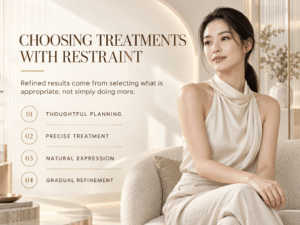
Facial balancing may include cosmetic injectables, biostimulating treatments, energy-based devices, regenerative options, or a combination tailored to your needs. A skilled plan does not automatically use every available modality. It selects the fewest interventions needed to create a visible, refined improvement.
Dermal fillers can restore or enhance contour with immediate results, but they require thoughtful placement and realistic expectations. Muscle-relaxing injections can soften dynamic lines and address certain muscle-driven concerns, yet excessive treatment may reduce expression. Devices that encourage collagen production tend to produce more gradual changes and may be better suited to clients who prioritize skin firmness and texture over added volume.
There are practical trade-offs as well. Injectable results are not permanent and usually require maintenance. Energy-based treatments may involve a series of sessions before changes become apparent. Regenerative therapies can be appealing for clients seeking a skin-focused approach, although outcomes vary and may be gradual. The best treatment is not the newest or most dramatic option. It is the one that suits your anatomy, goals, lifestyle, and comfort with maintenance.
Safety Is Part of the Luxury Experience
A refined result should never come at the expense of safety. Cosmetic treatments should be performed by appropriately qualified medical professionals in a clinical setting, following a clear assessment of suitability and risk.
Be candid about medical conditions, allergies, medications, previous procedures, and any history of cold sores, autoimmune conditions, bleeding concerns, or complications with injectables. Your provider should also explain likely downtime, aftercare, potential side effects, and signs that require prompt follow-up.
For injectable treatments, expertise in facial anatomy is essential. Vascular complications are uncommon but serious, and they require immediate recognition and management. A responsible provider will never minimize risk, pressure you into treatment, or promise that a result can be copied exactly from someone else’s photograph.
How to Prepare for Your Consultation
Bring reference images if they help communicate your aesthetic preference, but use them as a conversation starter rather than a blueprint. Images can show whether you prefer soft and understated refinement, sharper contour, restored volume, or a more hydrated, radiant skin finish.
It is equally helpful to describe what you do not want. Perhaps you are concerned about looking overfilled, frozen, or noticeably different to colleagues and friends. Those boundaries help your provider develop a plan that feels authentic to you.
Ask how the proposed treatment supports overall balance, what alternatives may be suitable, how long results typically last, and whether the approach can be staged. At Sky Beauty Cosmetic Clinic, personalized aesthetic care is built around these details, with treatment planning designed to support timeless confidence rather than a temporary trend.
The finest facial balancing result should leave people noticing that you look rested, polished, and entirely like yourself. Choose a provider who sees your face in full, explains each recommendation with clarity, and gives you the confidence to make decisions at your own pace.