

How Gravity Influences the Lower Face Over Time
Many people believe that gravity alone causes the face to “sag” with age. While gravity does influence facial appearance throughout life, it is only one part of a much more complex biological process. The way the lower face changes over time results from the interaction between gravity, skin, connective tissue, facial fat, muscles, ligaments, collagen, and the underlying facial skeleton.
Understanding how gravity influences the lower face helps explain why jawline definition may gradually soften with age and why facial changes over time cannot be attributed to a single factor.
Does Gravity Change the Face?
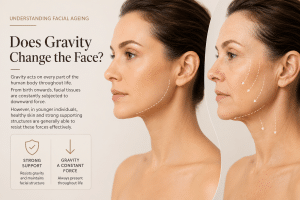
Gravity acts on every part of the human body throughout life.
From birth onwards, facial tissues are constantly subjected to downward force. However, in younger individuals, healthy skin and strong supporting structures are generally able to resist these forces effectively.
The appearance of the lower face is determined by how well the facial support system maintains the position of the skin and underlying soft tissues over time.
The Lower Face Is Supported by Multiple Structures
The jawline depends on several anatomical layers working together.
These include:
- Skin
- Collagen and elastin
- Connective tissue
- Retaining ligaments
- Facial fat compartments
- Facial muscles
- The jawbone (mandible)
These structures provide support, stability, and shape to the lower face.
As they naturally change with age, the influence of gravity may become more noticeable.
Gravity Does Not Act Alone
A common misconception is that gravity is the primary cause of facial changes over time.
Current understanding of facial anatomy recognises that ageing involves multiple biological changes occurring simultaneously.
These include:
- Gradual collagen natural changes
- Reduced skin elasticity
- Changes in connective tissue
- Redistribution of facial fat compartments
- Alterations in retaining ligaments
- Bone remodelling
Gravity interacts with these natural changes rather than acting independently.
How Skin Changes Influence Gravity’s Effects
Healthy skin contains collagen and elastin, two structural proteins that help maintain firmness and resilience.
As collagen and elastin naturally natural changes with age, the skin becomes less able to resist stretching and repeated movement.
This gradual reduction in structural support may allow gravity to have a greater influence on the appearance of the lower face over time.
The Role of Facial Fat Compartments
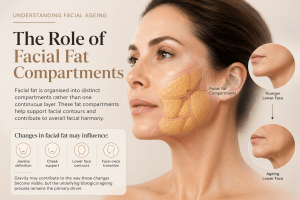
Facial fat is organised into distinct compartments rather than existing as one continuous layer.
These compartments help support facial contours and contribute to overall facial harmony.
Natural age-related changes in fat volume and position may influence:
- Jawline definition
- Cheek support
- Lower face contours
- The transition between the face and neck
Gravity may contribute to the way these changes become visible, but the underlying biological changes over time process remains the primary driver.
Connective Tissue and Retaining Ligaments
The skin and facial fat are supported by connective tissues and retaining ligaments.
These structures help maintain the position of soft tissues and contribute to facial stability.
Over time, natural changes within these supporting tissues may reduce their ability to provide the same level of structural support as in younger adulthood.
As a result, gravity may have a greater effect on the visible contours of the lower face.
Bone Structure Also Changes with Age
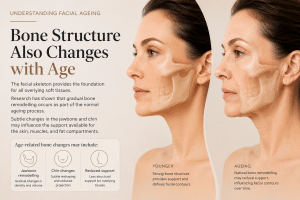
The facial skeleton provides the foundation for all overlying soft tissues.
Research has shown that gradual bone remodelling occurs as part of the normal changes over timeprocess.
Subtle changes in the jawbone and chin may influence the support available for the skin, muscles, and fat compartments.
These anatomical changes occur alongside the effects of gravity and contribute to evolving facial proportions over time.
Lifestyle May Influence Skin Health
Although gravity cannot be avoided, certain lifestyle factors support overall skin health.
These include:
- Daily sun protection
- Balanced nutrition
- Adequate sleep
- Avoiding smoking
- Regular physical activity
Healthy lifestyle habits support normal skin function but do not prevent the natural changes over time process or eliminate the effects of gravity.
Looking at the Whole Face
Modern facial assessment considers the relationship between all facial structures rather than focusing on gravity alone.
The appearance of the lower face reflects the interaction between:
- Skin quality
- Connective tissue
- Facial fat
- Muscles
- Retaining ligaments
- Bone structure
- Natural changes over time
- Gravity
Understanding these relationships provides a more complete picture of facial anatomy and lower face changes over time.
Conclusion
Gravity influences the lower face throughout life, but it is only one component of the natural changes over time process. Changes in collagen, elastin, connective tissue, facial fat compartments, retaining ligaments, muscles, and bone structure all contribute to the gradual evolution of jawline appearance over time.
Rather than acting as an isolated force, gravity interacts with these biological changes to influence how the lower face ages. Understanding this complex relationship provides valuable insight into facial anatomy and highlights why lower face ageing should always be viewed as a whole-face process rather than the result of a single factor.
At Sky Beauty Cosmetic Clinic Sydney CBD (World Square) and Macquarie Park, our team provides personalised consultations focused on understanding individual facial characteristics, skin quality, and aesthetic preferences. We take an individualised approach to facial assessment and discuss options that may be suitable based on each person’s unique needs and goals.