

CAN FACIAL AGEING BE MORE ABOUT STRUCTURE THAN WRINKLES?
When people think about facial ageing, wrinkles are often the first thing that come to mind. Fine lines around the eyes, forehead creases, and lines around the mouth have long been viewed as the most recognisable signs of getting older.
However, advances in facial anatomy research have transformed our understanding of the ageing process. Today, many practitioners recognise that wrinkles are only one component of facial ageing. In fact, some of the most significant age-related changes occur beneath the skin and involve the deeper structural support systems of the face.
This evolving understanding has led to an important question: can facial ageing be more about structure than wrinkles?
Increasingly, the answer appears to be yes.
Understanding Facial Ageing Beyond the Surface
The face is a complex three-dimensional structure made up of multiple layers.
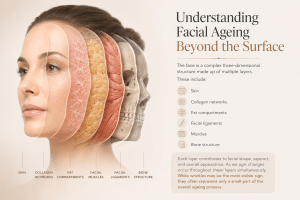
These include:
- Skin
- Collagen networks
- Fat compartments
- Facial ligaments
- Muscles
- Bone structure
Each layer contributes to facial shape, support, and overall appearance.
As we age, changes occur throughout these layers simultaneously. While wrinkles may be the most visible sign, they often represent only a small part of the overall ageing process.
Many structural changes begin years before noticeable wrinkles develop.
What Are Wrinkles?
Wrinkles are folds, lines, or creases that develop within the skin over time.
They are influenced by factors such as:
- Facial expressions
- Natural ageing
- Sun exposure
- Skin quality
- Collagen decline
Common examples include:
- Forehead lines
- Crow’s feet
- Frown lines
- Perioral lines
Wrinkles are primarily a surface-level change, although they may be influenced by deeper anatomical factors.
Because wrinkles are visible, they often attract the most attention when people assess facial ageing.
What Is Structural Ageing?
Structural ageing refers to changes occurring beneath the skin.
These changes affect the underlying support systems that help maintain facial shape and balance.
Structural ageing may involve:
- Reduced collagen support
- Changes in facial fat compartments
- Ligament weakening
- Tissue repositioning
- Skeletal remodelling
Unlike wrinkles, structural ageing affects facial architecture and overall facial contours.
These changes often influence how youthful or aged a face appears.
Why Some People Look Older Despite Having Few Wrinkles
Many individuals have relatively smooth skin yet still feel that their face looks older than it once did.
This is often because facial ageing is not determined solely by wrinkles.
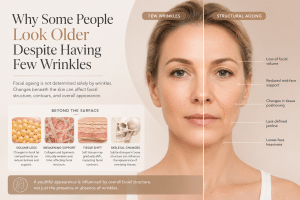
People may notice:
- Softer jawlines
- Flatter cheeks
- Less facial definition
- Changes in side profile appearance
- Lower-face heaviness
These concerns are frequently related to structural ageing rather than surface wrinkles.
This observation has played an important role in shifting aesthetic medicine towards a more comprehensive understanding of ageing.
The Role of Collagen in Facial Structure
Collagen is one of the body’s primary structural proteins.
Within the face, collagen contributes to:
- Skin firmness
- Tissue support
- Structural integrity
- Facial resilience
As collagen production gradually declines with age, support within the facial tissues also changes.
These changes may affect:
- Facial contours
- Skin quality
- Structural stability
- Overall facial balance
Because collagen supports multiple anatomical layers, it plays a significant role in structural ageing.
Changes in Facial Fat Compartments
Facial fat is not distributed evenly throughout the face.
Instead, it exists within specialised compartments that help support youthful facial contours.
These compartments contribute to:
- Cheek projection
- Mid-face support
- Facial proportions
- Lower-face balance
Over time, age-related changes can influence these structures.
As support changes, facial contours may appear different even when wrinkles remain relatively minimal.
This is one reason structural ageing is increasingly recognised as a key component of facial ageing.
The Importance of Facial Ligaments
Facial ligaments help anchor soft tissues and maintain facial support.
These structures play an important role in preserving facial architecture.
As the ageing process continues, ligament support may gradually change.
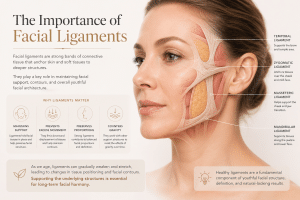
This can contribute to:
- Reduced contour definition
- Changes in tissue positioning
- Altered facial proportions
Although these changes occur beneath the skin, they can significantly influence visible facial appearance.
How Bone Structure Influences Ageing
One of the most important discoveries in modern facial ageing research involves the role of the facial skeleton.
Facial bones provide the foundation for all overlying tissues.
Research suggests that subtle changes in bone structure may occur over time in areas such as:
- Cheeks
- Chin
- Jawline
- Eye sockets
As the underlying framework evolves, the soft tissues above may also change in appearance.
This further supports the concept that facial ageing is largely structural in nature.
Why Modern Facial Assessment Has Changed
Historically, aesthetic consultations often focused heavily on wrinkles and surface concerns.
Today, practitioners increasingly assess:
- Facial support
- Structural balance
- Tissue integrity
- Facial proportions
- Skin quality
This shift reflects growing awareness that facial ageing is not simply a skin issue.
Instead, it involves complex interactions between multiple anatomical layers.
Understanding these interactions helps provide a more complete picture of the ageing process.
Facial Harmony and Perceived Age
Research and clinical observation suggest that perceived age is influenced by more than wrinkles alone.
People often associate youthfulness with:
- Facial definition
- Balanced contours
- Structural support
- Healthy skin quality
When structural support changes, facial harmony may be affected even if wrinkles remain relatively mild.
This is one reason modern facial rejuvenation discussions increasingly focus on overall facial balance rather than isolated lines and wrinkles.
Healthy Ageing and Structural Support
Healthy ageing has become a central theme in contemporary aesthetic medicine.
Many individuals are now interested in maintaining:
- Skin quality
- Facial structure
- Natural contours
- Long-term facial support
This approach reflects a broader understanding that ageing affects the entire face, not just the skin.
Supporting overall facial health often involves considering both visible and underlying changes.
Can Facial Ageing Be More About Structure Than Wrinkles?
Modern research suggests that facial ageing is often driven as much by structural changes as it is by wrinkles. While wrinkles remain an important and visible aspect of ageing, deeper changes involving collagen, facial support systems, fat compartments, ligaments, and bone structure frequently have a greater influence on overall facial appearance.
Understanding facial ageing from a structural perspective helps explain why facial contours, balance, and definition gradually change over time. This evolving understanding continues to shape contemporary approaches to facial assessment, healthy ageing, and facial rejuvenation.
At Sky Beauty Cosmetic Clinic Sydney CBD (World Square) and Macquarie Park, our experienced medical team provides personalised consultations to assess facial ageing concerns and discuss treatment options tailored to individual facial anatomy, skin quality, and long-term aesthetic goals.