

Can Loose Skin Around the Jawline Be Improved Without Surgery?

Loose skin around the jawline may become more noticeable with ageing, weight changes, sun exposure or reduced collagen and elastin. It can contribute to early jowls, a softer lower face and less separation between the jaw and neck.
For suitable clients, non-surgical treatments may support skin firmness and improve the appearance of mild to moderate laxity. However, the possible result depends on the amount of loose skin and whether other factors are also affecting the jawline.
At Sky Beauty Cosmetic Clinic Sydney CBD and Macquarie Park, the jawline, chin, lower cheeks, under-chin area and neck are assessed together before treatment options are discussed.
What Causes Loose Skin Around the Jawline?
Jawline skin may gradually become less firm due to:
• Reduced collagen production • Loss of skin elasticity • Ageing • Genetics • Cumulative sun exposure • Smoking • Hormonal changes • Weight gain or loss • Changes in facial fat distribution • Reduced support from deeper facial tissues
These changes do not occur at the same rate for everyone. Some people develop early jowls despite having relatively firm skin elsewhere on the face.
Is Loose Skin the Only Cause?
A less defined jawline is not always caused by skin laxity.
The appearance may also be influenced by:
• Fullness beneath the chin • Facial fat moving towards the lower cheeks • Limited chin projection • Natural jawbone structure • Strong chewing muscles • Neck muscle activity • Posture • Changes in body weight
If the main concern is fat, muscle activity or facial structure, a skin-firming procedure alone may provide limited improvement.
How Much Loose Skin Can Be Treated Non-Surgically?
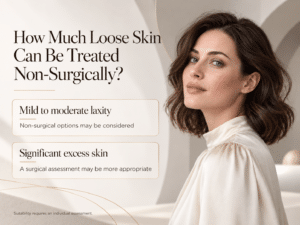
Non-surgical options are generally more appropriate for mild to moderate laxity. They may be considered when the skin looks slightly loose, crepey or less firm but does not form substantial folds.
Treatment may have greater limitations when there is:
• Significant hanging skin • Pronounced jowling • Large folds beneath the chin • Advanced neck laxity • Substantial tissue descent • An expectation of an immediate or dramatic lift
A consultation should provide an honest assessment of whether a non-surgical approach is likely to meet your goals.
How Do Energy-Based Treatments Work?
Energy-based treatments may use radiofrequency, ultrasound or other technologies to deliver controlled energy beneath the skin.
Depending on the device, this may support collagen remodelling and a gradual improvement in skin firmness. Treatment depth, settings and technique can vary between technologies.
The practitioner may consider:
• Skin thickness • Degree of laxity • Facial anatomy • Treatment area • Previous procedures • Medical history • Sensitivity and comfort • Expected recovery
These treatments do not remove excess skin. Results can also vary between clients.
Can Skin Quality Treatments Help?
When the skin is thin, dry or crepey, treatments focused on skin quality may be discussed.
Supporting hydration, texture and collagen function may help the skin appear healthier. However, improving skin quality is not the same as repositioning deeper tissue.
Skin quality treatments may have limited effect on pronounced jowls or significant lower-face laxity.
What If Under-Chin Fullness Is Also Present?
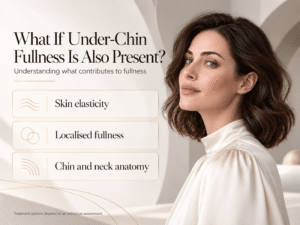
Under-chin fullness can make the jawline appear softer and may be mistaken for loose skin.
The practitioner should assess whether the fullness is related to:
• Localised fat • Loose skin • Natural anatomy • Chin projection • Neck structure • A combination of factors
An option intended to address fullness will not automatically tighten the skin. Reducing volume without assessing skin elasticity could also make existing laxity more noticeable in some clients.
Can Different Treatments Be Combined?
Some clients have more than one concern. For example, mild skin laxity may be present together with under-chin fullness or reduced structural support.
A combined or staged approach may be discussed when each treatment has a clear purpose. The practitioner should explain:
• What each treatment targets • Which treatment should be considered first • Whether the procedures can be performed together • Recommended treatment intervals • Possible side effects • Expected recovery • Total cost
More treatment does not necessarily mean a better outcome.
Who May Be Suitable for Non-Surgical Treatment?
A suitable candidate may be someone who:
• Has mild to moderate skin laxity • Understands that improvement may be gradual • Has realistic expectations • Is medically suitable for the proposed procedure • Prefers a non-surgical approach • Can follow preparation and aftercare instructions • Accepts that results may be subtle
Suitability cannot be determined by age alone.
Who May Not Be Suitable?
Treatment may need to be delayed or avoided in circumstances such as:
• Pregnancy or breastfeeding • Active infection or inflammation • Certain implanted medical devices • Recent facial surgery • Poor healing history • Uncontrolled health conditions • Use of certain medications • Significant excess skin • Expectations that cannot be achieved without surgery
Medical history and previous treatments should be disclosed during the consultation.
What Results May Be Realistic?
Non-surgical jawline treatment generally aims for a gradual and individualised improvement rather than a surgical-style lift.
Results may be influenced by:
• Age and genetics • Skin thickness and elasticity • Degree of laxity • Facial fat distribution • Chin and jaw structure • Muscle activity • Selected technology • Lifestyle and sun exposure • Individual collagen response
A particular amount of tightening or improvement cannot be guaranteed. The natural ageing process will also continue after treatment.
Is There Any Downtime?
Downtime depends on the selected treatment. Some procedures may cause temporary redness, swelling, tenderness or changes in sensation.
Other possible effects vary according to the technology, treatment settings and individual response. The practitioner should explain relevant risks, expected recovery and warning signs before treatment.
Clients should receive written preparation and aftercare instructions where appropriate.
When May Surgery Be More Appropriate?
Surgery may be more appropriate when excess skin needs to be removed or deeper tissues require significant repositioning.
A surgical assessment may be considered for:
• Substantial loose skin • Pronounced jowls • Significant neck laxity • Large skin folds • A desire for a major change • Limited response expected from non-surgical treatment
Non-surgical procedures cannot reproduce the results of a facelift or neck lift.
What Happens During a Jawline Consultation?
A lower-face consultation may assess:
• Skin thickness and elasticity • Degree of laxity • Jowls • Under-chin fullness • Chin projection • Jaw width and symmetry • Facial fat distribution • Neck skin and muscle activity • Previous cosmetic procedures • Medical history • Treatment goals and expectations
The face may be examined from the front, side and three-quarter views. Expression, posture and movement may also be considered.
Questions to Ask Before Treatment
Before deciding whether to proceed, ask:
• Is loose skin the main cause of my concern? • What does the proposed treatment target? • What improvement may be realistic? • What are the risks and possible side effects? • Is downtime expected? • Who will perform the treatment? • How many sessions may be discussed? • When will the result be reviewed? • What is included in the cost? • Would surgery provide a more appropriate option?
Choosing not to proceed is also a valid decision.
Jawline Consultation at Sky Beauty Sydney
Sky Beauty Cosmetic Clinic offers jawline and lower-face consultations at its Sydney CBD and Macquarie Park locations.