

How Can You Assess Skin Laxity Around the Jawline?

Skin laxity around the jawline may appear as early jowls, loose lower-face skin or reduced definition between the face and neck. However, a softer jawline is not always caused by loose skin.
Under-chin fullness, facial fat distribution, muscle activity, chin projection and natural bone structure can create a similar appearance. A proper assessment should therefore examine the whole lower face rather than focusing on one area.
At Sky Beauty Cosmetic Clinic Sydney CBD and Macquarie Park, consultations consider the jawline, chin, lower cheeks, under-chin area and neck before available options are discussed.
What Does Jawline Skin Laxity Look Like?
Possible signs of skin laxity include:
• Loose skin along the jaw • Early or established jowls • Crepey lower-face texture • Skin folding near the corners of the mouth • Reduced definition between the jaw and neck • Skin that moves more easily when touched • Differences between the two sides of the face
These signs can vary depending on facial expression, lighting, posture and head position.
Why Is a Visual Assessment Not Enough?
A photograph shows the outer appearance of the jawline, but it cannot always reveal which tissue is creating the concern.
What appears to be loose skin may be influenced by:
• Descending cheek tissue • Under-chin fullness • Strong chewing muscles • Limited chin projection • Neck muscle activity • Natural asymmetry • Camera angle or lens distortion
The skin and underlying tissues may need to be observed and gently examined in person.
How Is the Skin Examined?

During a consultation, the practitioner may look at:
• Skin thickness • Elasticity • Texture • Hydration • Fine lines • Crepey areas • Degree of skin movement • Jowl position • Sun-related changes • Scars or active skin conditions
The practitioner may gently examine the skin and underlying tissues to assess the degree of laxity and other factors contributing to the appearance.
This should be performed carefully and should not be treated as a guaranteed prediction of treatment results.
Why Is the Face Viewed From Different Angles?
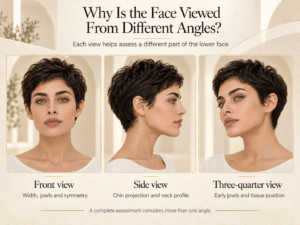
Jawline laxity may look different from the front, side and three-quarter views.
The front view may show:
• Lower-face width • Jowls • Symmetry • Muscle-related shape • The relationship between the chin and jaw
The side view may show:
• Chin projection • Under-chin fullness • The jaw-to-neck angle • Neck skin laxity • Overall profile balance
A three-quarter view may provide additional information about jowls and lower-face contours.
Why May the Practitioner Assess You During Movement?
The jawline can change when you smile, speak, clench your teeth or move your neck.
Movement may reveal:
• Strong chewing muscles • Downward muscle activity • Neck bands • Dynamic skin folding • Differences between resting and expressive positions • Natural asymmetry
This may help the practitioner assess the contribution of skin laxity and muscle activity to the overall appearance.
How Are Jowls Assessed?
Jowls are areas of tissue that become visible along the lower jaw, commonly near the corners of the mouth.
The practitioner may consider:
• Whether the jowl is mainly skin or deeper tissue • How far the tissue extends below the jawline • Whether both sides are similar • The position of facial fat • Support from the cheeks • Skin thickness and elasticity • The amount of underlying fullness
Jowls may involve several facial layers, and the suitability and limitations of different treatment approaches should be considered individually.
Why Is Under-Chin Fullness Assessed?
Under-chin fullness can reduce jawline definition and may be mistaken for loose skin.
The practitioner may assess whether the area contains:
• Localised fatty tissue • Loose skin • Thickened soft tissue • Natural anatomical fullness • Reduced chin projection • A combination of factors
Options intended to address under-chin fullness may not address skin laxity. Skin elasticity should also be considered when discussing treatment options.
What Role Does the Chin Play?
Chin projection affects how the jawline looks from the side.
Chin projection can influence the appearance of the jawline and the transition between the face and neck. Facial proportions should be considered as part of the overall assessment.
Assessing the chin does not mean treatment is automatically required. It helps explain how facial proportions influence the concern.
Why Is the Neck Included?
The jawline and neck form one continuous profile. Loose neck skin, under-chin fullness and neck muscle activity can all affect the visible border of the jaw.
The assessment may consider:
• Skin beneath the chin • Crepey neck texture • Vertical neck bands • Jaw-to-neck angle • Neck fullness • Posture • Previous neck treatments or surgery
Considering the jawline and neck together may provide a more comprehensive assessment of lower-face appearance.
Are Standardised Photographs Useful?
Clinical photographs may help document the starting point and support future comparison.
For useful photographs, the clinic may aim to keep the following consistent:
• Lighting • Camera distance • Head position • Facial expression • Background • Camera settings
Selfies taken with different lenses, filters or angles may make the jawline appear sharper or softer and are less reliable for comparison.
The clinic should explain how photographs will be stored and obtain appropriate consent before using them for marketing purposes.
What Medical Information Is Relevant?
Before treatment, disclose:
• Current medications and supplements • Allergies • Previous cosmetic treatments • Facial or neck surgery • Dental procedures • Implanted medical devices • Skin conditions • Nerve or muscle disorders • Healing or scarring concerns • Pregnancy or breastfeeding • Planned treatments with another provider
This information may influence whether a treatment is suitable and when it can be performed.
Can You Assess Jawline Laxity at Home?
You may notice changes by comparing recent photographs with older images taken in similar lighting and positions.
However, pulling the skin upwards in a mirror does not accurately predict the result of a cosmetic procedure. Home assessment also cannot reliably separate skin laxity from fat, muscle or structural concerns.
An in-person consultation with an appropriately qualified practitioner may help assess individual concerns and discuss suitable options.
What Happens After the Assessment?
Once the main cause has been identified, the practitioner may discuss:
• Energy-based skin-firming treatments • Treatments intended to support skin quality • Options for localised under-chin fullness • Approaches addressing muscle activity • Treatments considering facial balance and structure • Surgical referral for significant laxity • No treatment
Each proposed option should address a specific concern.
What Results May Be Realistic?
The possible outcome may depend on:
• Degree of laxity • Skin thickness and elasticity • Facial anatomy • Position of the jowls • Under-chin fullness • Age and genetics • Selected treatment • Previous procedures • Individual healing or collagen response
The extent of any improvement from non-surgical treatment varies between individuals. These approaches have limitations when addressing substantial excess skin and may not achieve the same degree of change as a surgical facelift or neck lift.
Jawline Assessment at Sky Beauty Sydney
Sky Beauty Cosmetic Clinic offers jawline and lower-face consultations at its Sydney CBD and Macquarie Park locations.