

Does HIFU Work? What Results Can You Expect

A sharper jawline, a subtly lifted brow, and firmer skin without surgery are compelling goals. But does HIFU work well enough to justify the treatment? For the right candidate, performed with the right device and an expertly designed protocol, HIFU can create a visible, natural-looking improvement in skin firmness and facial definition. It is not a replacement for a surgical facelift, and it should never be presented as one. Its value lies in refinement: stimulating your own collagen to support a fresher, more lifted appearance over time.
What HIFU does beneath the skin
HIFU stands for high-intensity focused ultrasound. Unlike treatments that work primarily on the surface, focused ultrasound energy is delivered at carefully selected depths beneath the skin. This creates tiny, controlled points of heat in targeted tissue while leaving the skin’s surface intact.
The body responds to this controlled stimulation by beginning a collagen-remodeling process. Collagen is one of the structural proteins responsible for skin’s resilience and density. As new collagen develops, the treated area may gradually appear firmer, smoother, and better supported.
Depending on the treatment area, HIFU may target the deeper foundational layers associated with facial support as well as more superficial dermal layers. That depth is what makes it particularly appealing for concerns such as early jowling, softening along the jawline, laxity beneath the chin, mild neck looseness, and a lowered-looking brow.
The key word is gradual. HIFU does not fill hollows, erase deep wrinkles overnight, or physically remove excess skin. It works with your biology, which is why results tend to look understated and evolve over several weeks.
Does HIFU work for skin tightening?
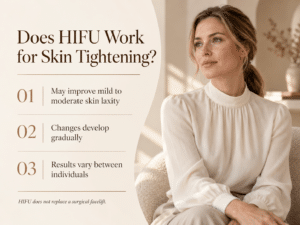
Yes, HIFU can work for mild to moderate skin laxity, especially when the skin still has enough natural elasticity to respond to collagen stimulation. Many clients notice an initial feeling of tightness shortly after treatment, but the more meaningful changes usually emerge over two to three months. Collagen remodeling can continue for up to six months.
The most successful outcomes are often subtle rather than dramatic. A client may see a cleaner transition from chin to neck, improved lower-face definition, or cheeks that appear slightly more supported. Friends may comment that they look rested or refreshed without being able to identify why. For those seeking elevated, natural-looking results, that discretion is often the point.
However, HIFU has limits. Skin with significant laxity, pronounced jowls, or substantial volume loss may need a more comprehensive approach. In these cases, ultrasound treatment may be combined with carefully placed dermal filler, biostimulating injectable treatments, RF microneedling, skin boosters, or other physician-guided options. A personalized plan is more likely to create facial harmony than asking one treatment to solve every concern.
Who is a good candidate for HIFU?
HIFU is often suited to adults who are beginning to notice a loss of firmness but do not want, need, or feel ready for surgery. It can be a considered choice for clients in their 30s through 60s, though skin quality and degree of laxity matter more than age alone.
A strong candidate typically has mild to moderate sagging around the lower face, jawline, neck, or brow area. They understand that collagen takes time to rebuild and want a natural enhancement rather than an instant transformation. HIFU can also be valuable as a maintenance treatment for someone committed to long-term skin quality.
It may be less suitable when there is very thin skin, substantial skin redundancy, active inflammation or infection in the treatment area, certain implanted medical devices, or a condition that affects healing. Pregnancy and breastfeeding are generally times to postpone elective aesthetic procedures. Your provider should take a complete health history, assess the skin and underlying facial structure, and discuss whether another option would serve your goals better.
Facial volume matters as much as skin laxity
One of the most common reasons clients feel disappointed by a skin-tightening treatment is that the primary issue was volume loss, not loose skin. As the face matures, it can lose structural support in the cheeks, temples, and lower face. This may create shadows, flattening, and folds that cannot be fully corrected by tightening alone.
An experienced aesthetic clinician evaluates the face as a whole. If lifting is appropriate, HIFU may be an excellent foundation. If volume restoration or hydration is also needed, a tailored combination plan can produce a more balanced and refined result.
What does a HIFU appointment feel like?

A HIFU appointment begins with assessment and treatment mapping. The provider identifies the areas that can benefit from focused ultrasound and selects depths appropriate to your anatomy and goals. Ultrasound gel is applied, then the handpiece delivers pulses in a planned pattern.
Most people describe brief moments of warmth, pressure, tingling, or a deeper prickling sensation. Comfort levels vary by area, energy setting, and individual sensitivity. The jawline and areas close to bone can feel more intense than the cheeks. A premium clinic should prioritize both efficacy and comfort by adjusting the protocol thoughtfully rather than using a one-size-fits-all approach.
There is usually little to no downtime. Mild redness, tenderness, temporary swelling, or sensitivity can occur and generally settle quickly. Some clients feel tenderness when touching the area for a few days. Your provider will give you specific aftercare based on the device used and your skin’s response.
How long do HIFU results last?
Results commonly last around 12 to 18 months, although this varies. Your age, baseline collagen levels, sun exposure, smoking status, skincare routine, weight fluctuations, and genetics all influence how the skin ages after treatment.
Some clients choose one focused treatment session and reassess after their collagen response has fully developed. Others include HIFU in an annual age-management plan. Maintaining results may also involve daily sunscreen, clinically appropriate skincare, and complementary in-clinic treatments that support skin quality.
It is worth being skeptical of promises that suggest permanent lifting or dramatic surgical-level change from a single session. HIFU can be highly effective, but honest treatment planning protects both your investment and your expectations.
Device quality and practitioner skill make a difference
Not all ultrasound devices, treatment settings, or protocols are equal. HIFU has become a broad marketing term, and the experience can vary considerably depending on the technology used, the provider’s training, and whether your treatment is customized to your facial anatomy.
Appropriate depth selection matters. Too superficial, and the treatment may not address the intended tissue. Too aggressive or poorly planned, and the treatment may be unnecessarily uncomfortable or unsuitable for the face. A knowledgeable provider knows when to treat, where to avoid, and when a different modality would be more appropriate.
In the United States, ask whether the device is authorized for its intended aesthetic use and who will be performing your treatment. You should also expect a consultation that includes realistic before-and-after examples, discussion of possible side effects, and a clear plan for follow-up. Expertise is not an added luxury in aesthetic medicine. It is central to safety and outcomes.
When HIFU is not the best answer
If your goal is immediate contouring for a special event, HIFU may not fit the timeline because its best results develop gradually. If you want to restore lost cheek volume, soften deep folds, or correct significant lower-face laxity, another treatment or a combination approach may be more effective.
There is also a difference between tightening skin and changing facial shape. HIFU can enhance definition where laxity is contributing to a softer contour, but it cannot create bone structure or replace volume that has been lost over time. The most elegant plans begin with an honest answer to what is actually causing the concern.
At Sky Beauty Cosmetic Clinic, personalized aesthetic care means considering your skin quality, facial proportions, lifestyle, and desired level of change before recommending any technology. The goal is not to chase a trend. It is to select treatments that support timeless confidence with results that still look like you.
If you are considering HIFU, book your consultation at a time when you can be thoughtful about your goals rather than rushing toward a quick fix. The right treatment should feel like a precise investment in your features, your skin, and the way you want to show up over time.