

Non-Surgical Lower Face Rejuvenation: A Patient Education Guide
The lower face can change gradually due to skin ageing, facial fat movement, muscle activity, weight fluctuations and changes in bone support. These factors may contribute to jowls, reduced jawline definition, under-chin fullness or changes in facial proportions.
Non-surgical lower-face rejuvenation is not one standard procedure. The appropriate approach depends on which tissues are contributing to the concern.
At Sky Beauty Cosmetic Clinic Sydney CBD and Macquarie Park, the lower face, chin, jawline, under-chin area and neck are assessed together before treatment options are discussed.
What Is Lower-Face Rejuvenation?
Lower-face rejuvenation describes cosmetic approaches intended to address selected concerns involving the area below the cheeks.
These may include:
• Reduced skin firmness • Mild or moderate laxity • Jowls • Crepey texture • Under-chin fullness • Lower-face width • Chin projection • Facial asymmetry • Changes around the mouth • The relationship between the jaw and neck
Rejuvenation does not necessarily mean changing the shape of the face. For some clients, the goal may be to support skin quality or create a more balanced appearance.
Why Does the Lower Face Change?
The lower face contains several interacting layers:
• Skin • Facial fat compartments • Ligaments and connective tissue • Muscles • Jawbone and chin structure • Under-chin tissue • Neck skin and muscles
Ageing and other changes do not affect every layer in the same way. Some people primarily experience reduced skin elasticity, while others notice tissue descent, fullness or muscle-related changes.
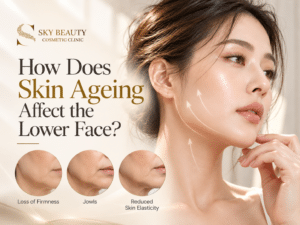
How Does Skin Ageing Affect the Lower Face?
Collagen supports skin structure, while elastin helps the skin stretch and return towards its original position.
As production of these proteins declines, the skin may become:
• Less firm • Less elastic • Thinner • Drier • More crepey • More affected by fine lines • Less able to support the lower-face outline
Sun exposure, smoking, hormonal changes and genetics may influence the timing and degree of these changes.
What Causes Jowls?
Jowls are areas of soft tissue that become visible along the lower jaw, commonly near the corners of the mouth.
They may involve:
• Loose skin • Movement of facial fat • Changes in supportive ligaments • Reduced cheek support • Age-related bone changes • Muscle activity • Genetics
Because jowls involve several layers, a surface-focused treatment may have limitations when deeper tissue changes are present.
Why Is Under-Chin Fullness Assessed Separately?
Under-chin fullness can reduce jawline definition but is not always caused by weight gain.
It may be influenced by:
• Genetics • Localised fatty tissue • Loose skin • Natural anatomy • Chin projection • Neck structure • A combination of factors
A treatment intended to address fullness may not tighten loose skin. Reducing volume without assessing skin elasticity may also make laxity more noticeable in some clients.
What Role Does the Chin Play?
The chin affects the balance of the lower face, particularly from the side.
Limited chin projection may:
• Reduce the visible length of the jawline • Make under-chin fullness appear more noticeable • Affect the jaw-to-neck angle • Change the balance between the nose, lips and lower face
There is no single ideal chin shape. Assessment should focus on individual facial proportions rather than applying the same standard to every client.
How Can Muscles Affect the Lower Face?
The size and activity of facial and neck muscles may influence lower-face shape.
Strong chewing muscles can create a broader jaw. Other muscles may contribute to downward tension, chin dimpling or visible neck bands.
Muscle-related concerns are different from skin laxity or facial fat and require a separate assessment.
Jaw pain, clicking, locking or difficulty chewing may require dental or medical evaluation.
What Non-Surgical Options May Be Discussed?
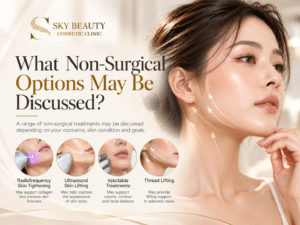
Depending on the assessment, treatment categories may include:
• Energy-based skin-firming procedures • Treatments intended to support skin quality • Options for localised under-chin fullness • Approaches addressing muscle activity • Treatments considering facial balance and structural support • Skincare and sun protection • Referral for surgical, medical or dental assessment • No treatment
Each option should address an identified concern and have a clear purpose.
What Can Energy-Based Treatments Do?
Energy-based treatments may use radiofrequency, ultrasound, laser or another form of controlled energy.
Depending on the technology, treatment may be intended to support collagen remodelling, skin firmness or texture.
Results vary according to:
• Treatment type • Settings and technique • Skin thickness • Degree of laxity • Treatment area • Medical history • Individual response
These procedures cannot remove significant excess skin or reproduce the result of surgery.
What Can Skin-Quality Treatments Do?
Skin-quality treatments may be discussed for concerns involving:
• Fine lines • Dryness • Crepey texture • Uneven skin surface • Reduced firmness • General skin condition
Improving skin quality does not necessarily reposition deeper facial tissue or significantly change lower-face proportions.
The practitioner should explain whether the proposed treatment focuses on hydration, texture, firmness or another specific concern.
Can Several Treatments Be Combined?
Some clients have more than one lower-face concern. A combined or staged plan may be considered when each treatment has a clear purpose.
Before agreeing to multiple procedures, ask:
• What does each treatment target? • Which concern should be addressed first? • Can the result be reviewed before adding another procedure? • What are the combined risks? • What recovery should be expected? • What is the total cost?
More treatment does not automatically produce a better result.
Who May Be Suitable?
A suitable client may be someone who:
• Has a clearly identified cosmetic concern • Has realistic expectations • Is medically suitable for the proposed procedure • Understands the risks and limitations • Can follow preparation and aftercare instructions • Accepts that results may be gradual or subtle • Has had enough time to make an informed decision
Age alone does not determine suitability.
Who May Not Be Suitable?
Treatment may need to be delayed or avoided in circumstances such as:
• Pregnancy or breastfeeding • Active infection or inflammation • Recent facial surgery • Certain implanted medical devices • Poor healing history • Uncontrolled medical conditions • Use of certain medications • Significant excess skin • Expectations that cannot be achieved non-surgically
Suitability depends on the particular procedure and individual medical history.
What Risks Should Be Discussed?
Risks vary between treatments but may include:
• Redness • Swelling • Bruising • Tenderness • Changes in sensation • Skin irritation • Pigment changes • Asymmetry • Uneven results • Infection • Scarring • Limited improvement
Some procedures carry rare but serious risks. The practitioner should explain warning signs and how complications are managed.
When May Surgery Be More Appropriate?
Surgical assessment may be more appropriate when there is:
• Significant hanging skin • Pronounced jowling • Substantial neck laxity • Large folds beneath the chin • A need to remove or reposition tissue • A desire for a major or immediate change
Non-surgical treatment cannot reproduce the result of a facelift or neck lift.
What Happens During a Consultation?
A lower-face consultation may assess:
• Skin thickness and elasticity • Jowls and tissue position • Facial fat distribution • Under-chin fullness • Jaw shape and symmetry • Chin projection • Muscle activity • Neck skin and profile • Previous cosmetic procedures • Medical and dental history • Personal goals and expectations
The face may be viewed from the front, side and three-quarter angles, both at rest and during movement.
Lower-Face Consultation at Sky Beauty Sydney
Sky Beauty Cosmetic Clinic offers lower-face rejuvenation consultations at its Sydney CBD and Macquarie Park locations.