

Jawline Tightening vs Jawline Contouring: What’s the Difference?
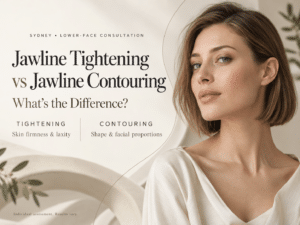
Jawline tightening and jawline contouring are often used interchangeably, but they do not always describe the same cosmetic goal.
Jawline tightening usually focuses on skin firmness and laxity. Jawline contouring is a broader term that may involve the shape, width, projection and overall proportions of the lower face.
Understanding the difference can help you ask more useful questions during a consultation. At Sky Beauty Cosmetic Clinic Sydney CBD and Macquarie Park, the jawline is assessed together with the chin, lower cheeks, under-chin area and neck before treatment options are discussed.
What Is Jawline Tightening?
Jawline tightening generally refers to approaches intended to improve the appearance of loose or less firm skin around the lower face.
It may be considered when the concern involves:
• Mild skin laxity • Early jowls • Reduced skin elasticity • Crepey lower-face skin • Less visible separation between the jaw and neck • Age-related changes in firmness
Depending on the client, energy-based procedures or treatments focused on skin quality may be discussed.
These treatments aim to support the skin rather than significantly alter the underlying facial structure.
What Is Jawline Contouring?
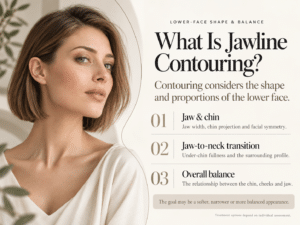
Jawline contouring focuses on the overall shape and proportions of the lower face.
The concern may involve:
• Jaw width • Chin projection • Lower-face symmetry • Under-chin fullness • Strong chewing muscles • The transition between the jaw and neck • The balance between the chin, cheeks and jaw
Contouring does not always mean making the jawline sharper. For some people, the goal may be a softer, narrower or more balanced lower face.
What Is the Main Difference?
The simplest distinction is that tightening primarily addresses skin quality and laxity, while contouring considers the shape and proportion of the entire lower face.
However, the two concerns can overlap. Loose skin may affect the jawline’s shape, while structural or volume-related concerns may make laxity appear more noticeable.
A person seeking contouring may also require an assessment of skin firmness. Likewise, a person requesting tightening may discover that under-chin fullness or limited chin projection is contributing to the concern.
How Can You Tell Which Concern You Have?
It may be difficult to identify the cause by looking in the mirror or at photographs.
A practitioner may consider whether the jawline changes when:
• The skin is gently repositioned • The head turns to the side • The chin moves forward • The neck bends • The jaw muscles contract • Lighting or posture changes
These observations may help determine whether the concern is mainly related to skin, fat, muscle, structure or a combination of factors.
When May Jawline Tightening Be Discussed?
Jawline tightening may be considered when the skin has become mildly or moderately loose but there is no substantial excess tissue.
A suitable client may notice:
• Early jowl formation • Reduced firmness along the jaw • Mild crepey texture • Gradual changes associated with ageing • Skin changes after weight loss • A softer jawline despite stable body weight
Non-surgical tightening generally produces a gradual and individualised change. It cannot remove significant excess skin or reproduce the results of surgery.
When May Jawline Contouring Be Discussed?
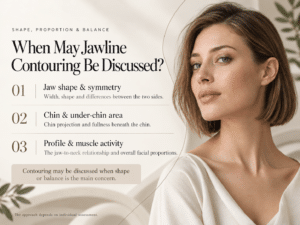
Jawline contouring may be discussed when the main concern is the overall shape or balance of the lower face.
The assessment may focus on:
• Whether the jaw appears wide or narrow • How far the chin projects • Whether one side differs from the other • The amount of fullness beneath the chin • The relationship between the jaw and neck • Muscle activity • Facial proportions from the front and side
The proposed approach depends on which feature is creating the concern.
What Treatment Categories May Be Considered?
Depending on the assessment, treatment categories may include:
• Energy-based skin-firming procedures • Treatments intended to support skin quality • Options for localised under-chin fullness • Approaches addressing muscle activity • Treatments considering facial balance and structural support • Surgical referral for significant skin laxity or structural change
Some cosmetic procedures are regulated differently from general beauty services in Australia. An appropriate consultation and informed consent process may be required before certain options can be recommended or performed.
Can Tightening Change the Shape of the Jawline?
Improving mild skin laxity may make the jawline appear more defined, but tightening does not directly change the jawbone or chin.
If the main concern is limited chin projection, a wide lower face or significant under-chin fullness, skin tightening alone may provide limited improvement.
The practitioner should explain which part of the jawline may change and which features are unlikely to be affected.
Can Contouring Tighten Loose Skin?
Not necessarily. A treatment intended to change volume, muscle activity or facial proportion may not improve skin elasticity.
In some cases, reducing fullness without considering skin quality may make pre-existing laxity more visible. This is why the skin should be assessed before a contouring plan is selected.
A staged approach may be discussed when both contour and laxity are concerns.
Can Both Approaches Be Combined?
Some clients may have mild skin laxity together with under-chin fullness, strong jaw muscles or limited structural support.
A combined approach may be considered when each treatment has a clear purpose. The practitioner should explain:
• What each option targets • Which concern should be addressed first • Whether treatments can be performed together • Appropriate treatment intervals • Possible risks and recovery • Expected limitations • Total cost
More procedures do not automatically produce a better result.
What Happens During the Assessment?
A jawline consultation may assess:
• Skin thickness and elasticity • Degree of laxity • Position of the jowls • Facial fat distribution • Under-chin fullness • Jaw width and shape • Chin projection • Muscle activity • Facial symmetry • Neck skin and profile • Previous cosmetic procedures • Medical history • Personal preferences and expectations
The lower face may be viewed from the front, side and three-quarter angles. Expression, posture and movement may also be assessed.
Which Questions Should You Ask?
Before deciding whether to proceed, ask:
• Is my main concern laxity or facial shape? • What is causing the appearance I want to change? • Does the proposed treatment tighten, contour or both? • What result may be realistic for me? • What are the risks and possible side effects? • Is downtime expected? • Who will perform the treatment? • How many sessions may be discussed? • When should the result be reviewed? • What is included in the cost? • Are there other options, including no treatment?
Clear answers can help you understand whether the proposed plan matches your goals.
What Results Are Realistic?
Results vary depending on:
• Age and genetics • Skin quality • Degree of laxity • Facial structure • Fat distribution • Muscle activity • Treatment selected • Lifestyle and sun exposure • Previous procedures • Individual healing or collagen response
Non-surgical treatments generally provide more subtle changes than surgery. They cannot guarantee a particular jaw shape or permanently prevent future ageing.
Jawline Consultation at Sky Beauty Sydney
Sky Beauty Cosmetic Clinic offers lower-face and jawline consultations at its Sydney CBD and Macquarie Park locations.