

Jawline Tightening in Australia: What You Should Know Before a Consultation

A softer or less defined jawline may develop gradually due to ageing, genetics, skin laxity, facial structure or changes in the tissues beneath the skin. Some people notice jowls, under-chin fullness or reduced separation between the face and neck, even when their body weight has not changed.
Jawline tightening is not one specific procedure. The most appropriate option depends on what is causing the concern. Before considering cosmetic treatment in Australia, an individual consultation is important to assess the lower face and discuss realistic expectations, potential risks and alternative approaches.
At Sky Beauty Cosmetic Clinic Sydney CBD and Macquarie Park, the jawline is assessed together with the chin, cheeks, under-chin area and neck.
What Can Make the Jawline Look Less Defined?
Several factors may influence jawline definition, including:
• Reduced collagen and elastin • Loose or crepey skin • Changes in facial fat distribution • Jowls around the lower cheeks • Localised fullness beneath the chin • Chin shape and projection • Jawbone structure • Muscle activity • Neck skin laxity • Weight fluctuations • Genetics and natural facial proportions
More than one factor may be present. This is why selecting a treatment based only on a photograph or one visible feature may not provide an appropriate plan.
Is the Main Concern Really Skin Laxity?
The term “sagging jawline” is often used to describe several different concerns. However, the appearance may not be caused entirely by loose skin.
For example, a jawline may appear less defined because of under-chin fullness, a recessed chin, strong chewing muscles or tissue descending from the lower cheeks. Neck posture and camera angle may also change how the area appears.
A consultation should determine whether the main concern involves skin, fat, muscle, structure or a combination of these factors.
How Is the Jawline Assessed?
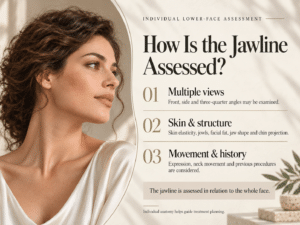
A practitioner may assess the face from the front, side and three-quarter views. The lower face may also be examined while you are speaking, smiling or moving your neck.
The assessment may consider:
• Skin thickness and elasticity • Degree of lower-face laxity • Position of the jowls • Facial fat distribution • Under-chin fullness • Jaw width and shape • Chin projection • Facial symmetry • Neck skin and muscle activity • Previous cosmetic procedures • Scars or active skin conditions • Overall facial proportions
The goal is not to create a standard jaw shape. It is to understand how the jawline relates to the rest of the individual’s face.
What Treatments May Be Discussed?
Depending on the assessment, a practitioner may discuss treatment categories such as:
• Energy-based skin-firming procedures • Treatments intended to support skin quality • Options for localised under-chin fullness • Approaches addressing muscle activity • Treatments focused on facial balance and structural support • Surgical referral for substantial skin laxity
These approaches are not interchangeable. A treatment intended to improve skin firmness will not necessarily address excess fat, muscle activity or significant structural imbalance.
In Australia, some cosmetic treatments are regulated differently from general beauty services. A consultation may be required before certain options can be recommended or provided.
What Can Non-Surgical Jawline Tightening Achieve?
Non-surgical treatment may be considered for selected clients with mild to moderate changes. Depending on the approach, the aim may be to support skin firmness, improve the appearance of early laxity or create a more balanced lower-face profile.
Results are generally gradual and vary between individuals. Non-surgical treatment cannot remove a large amount of excess skin or reproduce the outcome of a surgical facelift or neck lift.
A responsible consultation should explain both the possible benefits and the limitations.
Who May Not Be Suitable?

Suitability depends on the proposed procedure, medical history and condition of the treatment area.
Treatment may need to be delayed or avoided in some circumstances, including:
• Pregnancy or breastfeeding • Active infection or inflammation • Certain implanted medical devices • Recent facial surgery • Poor healing history • Uncontrolled medical conditions • Certain medications • Significant excess skin requiring surgical assessment • Unrealistic expectations about the result
The practitioner should review your health information before recommending a treatment plan.
What Medical Information Should You Disclose?
Provide complete and accurate information about:
• Current medications and supplements • Allergies • Previous cosmetic treatments • Facial surgery or dental procedures • Implanted medical devices • Pregnancy or breastfeeding • Skin conditions • Nerve or muscle disorders • Problems with healing or scarring • Planned treatments with another provider
Even information that seems unrelated may affect treatment suitability, timing or aftercare.
What Questions Should You Ask?
Useful questions to ask during a jawline consultation include:
• What is causing my jawline concern? • Which area would be treated? • What result may be realistic for me? • What are the possible risks and side effects? • Is there any downtime? • Who will perform the treatment? • What qualifications and experience do they have? • How many sessions may be discussed? • When should the result be reviewed? • What is included in the quoted cost? • What happens if I experience a complication? • Are there alternatives, including no treatment?
You should have enough information and time to make an informed decision without feeling pressured.
Should You Bring Reference Photos?
Reference photos may help explain what you like, but they should not be treated as a guaranteed outcome.
Jaw shape is influenced by bone structure, tissue distribution and facial proportions. A result seen on another person may not be achievable or suitable for your face.
Photos of your own jawline from previous years may sometimes be more useful because they show how your facial structure and skin have changed over time.
Why Are Photos Taken During the Consultation?
Standardised photographs may be used to document the starting point and support future comparison.
Lighting, facial expression, camera distance, posture and head position can significantly change the apparent jawline. Consistent photographs are more useful than selfies taken with different angles or filters.
The clinic should explain how your images will be stored and obtain separate consent before using them for marketing or educational purposes.
How Much Does Jawline Tightening Cost?
The cost depends on the identified concern, selected treatment, practitioner, number of sessions and size of the area.
An accurate quotation usually cannot be provided until the jawline has been assessed. Ask whether the price includes consultation, treatment, follow-up review and any required aftercare.
Cost should not be the only factor when selecting a clinic. Practitioner qualifications, treatment suitability, informed consent and access to follow-up care are also important.
What Results Are Realistic?
Results may be influenced by:
• Age and genetics • Skin thickness and elasticity • Degree of laxity • Facial structure • Under-chin fullness • Muscle activity • Lifestyle and sun exposure • Previous procedures • Individual healing and collagen response
No cosmetic treatment can guarantee a particular degree of tightening or create permanent protection against future ageing.
Jawline Consultation at Sky Beauty Sydney
Sky Beauty Cosmetic Clinic offers lower-face and jawline consultations at its Sydney CBD and Macquarie Park locations.