

Can DPL Help With Uneven Skin Tone?

Uneven skin tone is one of those concerns that can be difficult to describe. Your skin may feel smooth, yet when you look in the mirror, the complexion appears patchy, dull or less clear than it used to.
For some people, the problem is scattered brown pigmentation. For others, it may be facial redness, post acne marks or years of sun exposure. Often, several of these concerns appear at the same time.
For people researching DPL for uneven skin tone in Macquarie Park, DPL may be one light based treatment worth discussing during a professional skin consultation.
The important question, however, is not simply whether DPL can make skin look brighter.
It is what is actually causing your uneven skin tone?
What Does “Uneven Skin Tone” Actually Mean?
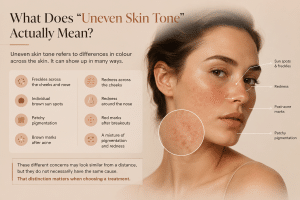
Uneven skin tone is not a specific diagnosis.
It is a general description of differences in colour across the skin.
You might notice:
- Freckles across the cheeks and nose
- Individual brown sun spots
- Patchy pigmentation
- Redness across the cheeks
- Redness around the nose
- Brown marks after acne
- Red marks after breakouts
- A mixture of pigmentation and redness
These different concerns may look similar from a distance, but they do not necessarily have the same cause.
That distinction matters when choosing a treatment.
What Is DPL?
DPL, or Delicate Pulsed Light, is a form of narrow spectrum light-based technology.
Traditional IPL delivers a relatively broad spectrum of light. Narrow spectrum systems filter this range so that selected wavelengths can be used to interact with particular targets in the skin.
Two important targets are melanin and haemoglobin.
Melanin contributes to brown pigmentation, while haemoglobin is relevant to redness and certain visible vascular concerns.
Clinical consensus on narrow band IPL describes its use for superficial pigmentation, vascular concerns and photoageing, with wavelength selection depending on the intended target.
This is one reason DPL may be discussed when uneven skin tone involves both brown and red areas.
How May DPL Help With Brown Pigmentation?
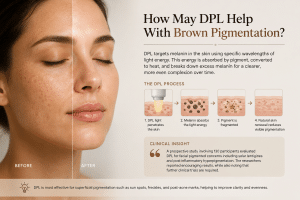
If uneven skin tone is being caused by suitable superficial pigmentation, melanin becomes an important treatment target.
During light based treatment, melanin absorbs selected light energy. This energy interacts with the appearance of targeted pigment.
Over time, the appearance of suitable superficial pigmentation may become less noticeable.
DPL has been specifically studied for facial pigmented concerns. A prospective study involving 130 participants evaluated DPL for conditions including solar lentigines and post inflammatory hyperpigmentation. The researchers reported encouraging results while also noting that further clinical trials are required.
This does not mean that every brown mark should automatically be treated with DPL.
The type of pigmentation still needs to be identified first.
What About Facial Redness?
Uneven skin tone is not always brown.
Some people have relatively little pigmentation but notice persistent pink or red areas across the cheeks and around the nose.
Others may have redness remaining after acne.
Because haemoglobin can absorb selected wavelengths of light, narrow spectrum pulsed light has also been investigated for vascular concerns.
Clinical research comparing narrow and broad spectrum IPL for post acne erythema found improvement in the narrow spectrum vascular treatment group.
More recent research has also evaluated DPL specifically for post acne erythema.
The treatment approach for redness, however, may differ from the approach used for brown pigmentation.
What If You Have Both Redness and Pigmentation?
This is very common.
Someone may have sun spots across the cheeks but also experience redness around the nose. Another person may have brown post acne marks along the jawline and red marks on the cheeks.
This mixture of colours can make the overall complexion appear particularly uneven.
A skin consultation can help identify whether the concern is primarily pigment related, vascular or a combination of both.
The treatment plan can then be based on what is actually visible in your skin rather than simply treating the entire face in exactly the same way.
Can DPL Make Skin Look Brighter?
When people ask for “brighter skin”, they often do not mean changing their natural skin colour.
What they usually want is skin that looks clearer, fresher and more even.
Scattered pigmentation and redness create visual contrast across the complexion. When suitable areas of discolouration become less noticeable, the overall skin tone may consequently appear more balanced.
Research into IPL skin rejuvenation has demonstrated improvement in irregular pigmentation and telangiectasia following treatment.
The goal of DPL should therefore not be to make someone’s natural complexion lighter.
It is to address appropriate areas of visible colour irregularity.
Can DPL Help With Sun Related Uneven Skin Tone?
Years of UV exposure can contribute to freckles, solar lentigines and irregular pigmentation.
This is particularly relevant for people who have accumulated significant sun exposure over time.
You may notice that pigmentation becomes more obvious across areas such as the cheeks, temples and forehead.
For suitable superficial sun related pigmentation, DPL may be discussed as part of a broader skin rejuvenation plan.
However, treating existing pigmentation does not prevent new sun damage from developing.
Consistent sun protection remains an important part of managing uneven pigmentation over the longer term.
What About Post Acne Marks?
After a breakout settles, the skin may remain discoloured.
Some people develop flat brown marks, while others are left with red areas.
These are not the same as indented acne scars.
DPL may be discussed when the main concern is suitable residual colour after acne, but it should not be expected to correct every type of acne scar.
If your main concern is deep or indented scarring, another treatment approach may be more appropriate.
Is DPL Suitable for Melasma?
Melasma requires particular consideration.
Although it creates areas of brown pigmentation, melasma is more complex than an isolated freckle or sun spot.
Its appearance may be influenced by factors including hormones, genetics and light exposure.
For this reason, someone with suspected melasma should have the pigmentation assessed carefully rather than assuming that DPL is automatically appropriate.
The same principle applies to unusual or changing pigmented lesions. These should be assessed appropriately before cosmetic treatment.
How Many DPL Sessions Are Needed for Uneven Skin Tone?
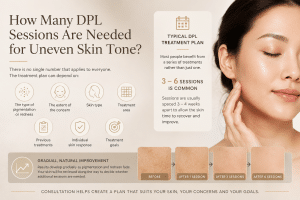
There is no single number that applies to everyone.
The treatment plan can depend on:
- The type of pigmentation or redness
- The extent of the concern
- Skin type
- Treatment area
- Previous treatments
- Individual skin response
- Treatment goals
Clinical studies of light based skin rejuvenation frequently involve a series of treatments rather than relying on a single session. For example, a randomised controlled IPL study used three treatments and reported significant improvement in irregular pigmentation and telangiectasia.
Your skin can therefore be reviewed during the treatment process before deciding whether additional sessions may be appropriate.
Why Is a Consultation Important?
“Uneven skin tone” tells us how the skin looks, but it does not tell us why it looks that way.
During a consultation, your practitioner may assess your skin type, pigmentation pattern, areas of redness, sun exposure, previous treatments and current skincare.
Your goals also matter.
For one person, success may mean making scattered freckles less noticeable.
For another, it may mean reducing the appearance of redness.
Someone else may simply want the complexion to look more balanced overall.
These differences can influence whether DPL is suitable and how treatment may be approached.
DPL for Uneven Skin Tone in Macquarie Park
If pigmentation, redness, sun related changes or post acne marks are making your complexion look less even, DPL may be one option worth discussing.
The aim should not be to change your natural skin colour or promise flawless skin.
Instead, treatment begins by identifying what is creating the uneven appearance and determining whether those concerns are appropriate targets for DPL.
Because when someone says:
“I want more even skin,”
the first question should always be:
“What is making your skin look uneven in the first place?”
Once that is understood, a more personalised skin rejuvenation plan can be considered.