

Why Does the Jawline Look Different in Photos?
Many people have looked at a photograph and wondered why their jawline appears less defined than it does in the mirror. In some photos, the lower face looks sharp and balanced, while in others the jawline may appear softer, fuller, or less symmetrical.
This is a very common experience. In most cases, the jawline has not actually changed. Instead, the way it appears is influenced by photography, lighting, camera position, facial posture, and the natural three-dimensional structure of the face.
Understanding why the jawline can look different in photos helps explain how facial anatomy and visual perception work together to influence our appearance.
The Face Is Three-Dimensional
The human face is a three-dimensional structure.
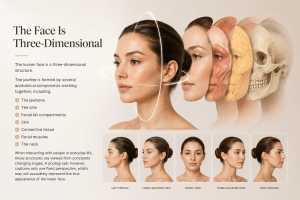
The jawline is formed by several anatomical components working together, including:
- The jawbone
- The chin
- Facial fat compartments
- Skin
- Connective tissue
- Facial muscles
- The neck
When interacting with people in everyday life, these structures are viewed from constantly changing angles. A photograph, however, captures only one fixed perspective, which may not accurately represent the true appearance of the lower face.
Camera Angle Can Change Jawline Definition
Camera angle is one of the biggest reasons the jawline may appear different in photographs.
Small changes in camera position can alter how facial proportions are perceived.
For example:
- A camera positioned below the face may make the lower face appear fuller.
- A high camera angle may reduce the visibility of the jawline.
- A side-profile image highlights facial projection differently from a front-facing photograph.
- Slight head rotation changes the visibility of facial contours.
These optical differences can make the same jawline appear more or less defined without any actual change in facial anatomy.
Head Position Influences Facial Contours
The position of the head and neck also affects how the jawline appears.
Simple posture changes may alter the relationship between the chin, jawline, and neck.
For example:
- Looking slightly upward may create a clearer jawline.
- Looking downward may make the transition between the chin and neck appear softer.
- Turning the head slightly changes how facial shadows are formed.
These effects are completely normal and occur because photography captures only one moment from one viewpoint.
Lighting Creates the Illusion of Definition
Lighting has a significant impact on facial appearance.
Light and shadow help define facial contours by creating contrast across the face.
Depending on the lighting direction, photographs may show:
- More visible jawline shadows
- Softer facial contours
- Greater skin texture
- Reduced lower face definition
Professional photographers often use carefully controlled lighting because it can dramatically influence how facial structure appears.
Smartphone Cameras Can Distort Facial Features
Modern smartphones often use wide-angle lenses, particularly for selfies.
When a photograph is taken at a very close distance, these lenses may slightly distort facial proportions.
This can make certain areas appear:
- Wider
- Narrower
- Larger
- Closer to the camera
Because the lower face is positioned differently from the upper face, lens distortion may influence how the jawline appears in selfies compared with photographs taken from further away.
Facial Expression Changes the Jawline
Facial muscles constantly move during speaking, smiling, and everyday expression.
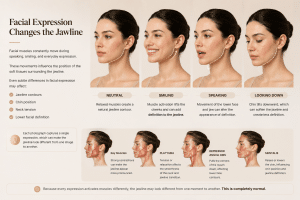
These movements influence the position of the soft tissues surrounding the jawline.
Even subtle differences in facial expression may affect:
- Jawline contours
- Chin position
- Neck tension
- Lower facial definition
Because every photograph captures a single expression, the jawline may look different from one image to another.
Natural Facial Asymmetry Is Normal
Perfect facial symmetry is uncommon.
Most people have small differences between the left and right sides of their face.
Photographs may make these natural variations appear more noticeable because they capture only one viewing angle under specific lighting conditions.
These differences are usually much less obvious during normal face-to-face interaction.
Facial Structure Remains the Same
Although photographs may change the appearance of the jawline, they do not change the underlying facial anatomy.
Jawline definition continues to depend on:
- Bone structure
- Skin quality
- Collagen support
- Facial fat compartments
- Retaining ligaments
- Facial muscles
Photography simply changes how these structures are viewed.
Ageing May Influence How the Jawline Photographs
Natural ageing gradually affects the lower face.
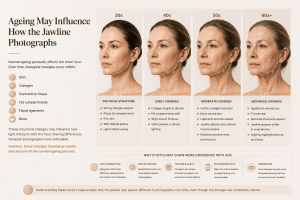
Over time, biological changes occur within:
- Skin
- Collagen
- Connective tissue
- Fat compartments
- Facial ligaments
- Bone
These structural changes may influence how light interacts with the face, making differences between photographs more noticeable.
However, these changes develop gradually and are part of the normal ageing process.
Facial Harmony Is More Important Than One Photograph
Modern aesthetic medicine focuses on facial harmony rather than a single image.
The appearance of the jawline depends on its relationship with:
- The cheeks
- The chin
- The neck
- The lower face
- Overall facial proportions
Because facial balance is created by multiple structures working together, one photograph rarely provides a complete representation of facial appearance.
Comprehensive facial assessment considers the face from multiple viewpoints, different lighting conditions, and both resting and natural facial expressions.
Understanding Visual Perception
The brain interprets facial appearance using depth, movement, lighting, and symmetry.
A still photograph removes many of these visual cues, making facial features appear different from how they are perceived in person.
This is one reason why people often feel they look different in photos compared with what they see in the mirror.
Recognising the influence of visual perception helps explain why photographs do not always reflect the true appearance of the jawline.
Conclusion
It is completely normal for the jawline to look different in photographs. Camera angle, lighting, head position, facial expression, lens distortion, and natural facial asymmetry all influence how the lower face is captured. These factors can significantly affect the appearance of jawline definition without any actual change in facial anatomy.
Understanding the relationship between photography, facial structure, and visual perception provides valuable insight into why the jawline may appear different from one image to another. Rather than relying on a single photograph, modern facial assessment considers facial anatomy, facial harmony, and lower face structure from multiple perspectives.
At Sky Beauty Cosmetic Clinic Sydney CBD (World Square) and Macquarie Park, our experienced medical team provides personalised consultations to assess jawline concerns, facial structure, and lower face ageing. We take an individualised approach to understanding facial anatomy and discuss treatment options tailored to each person’s unique facial features, skin condition, and aesthetic goals.