

WHAT HAPPENS BENEATH THE SKIN DURING FACIAL AGEING?
When most people think about facial ageing, they often focus on what they can see in the mirror. Fine lines, wrinkles, skin laxity, and changes in facial contours are among the most commonly recognised signs of ageing. However, many of the visible changes associated with ageing actually begin beneath the skin long before they become noticeable on the surface.
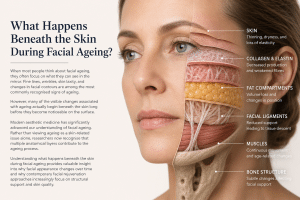
Modern aesthetic medicine has significantly advanced our understanding of facial ageing. Rather than viewing ageing as a skin-related issue alone, researchers now recognise that multiple anatomical layers contribute to the ageing process. Changes occur within the skin, connective tissues, fat compartments, ligaments, muscles, and even the facial skeleton.
Understanding what happens beneath the skin during facial ageing provides valuable insight into why facial appearance changes over time and why contemporary facial rejuvenation approaches increasingly focus on structural support and skin quality.
Facial Ageing Is a Multi-Layered Process
The face is a complex structure made up of several interconnected layers.
These include:
- Skin
- Collagen and elastin networks
- Fat compartments
- Facial ligaments
- Muscles
- Bone structure
Each layer contributes to facial shape, support, and overall appearance.
As we age, changes occur across all of these layers simultaneously. This is why facial ageing is now viewed as a structural process rather than simply a surface concern.
Changes Within the Skin
The skin is often where ageing becomes most visible.
Over time, natural biological processes influence the skin’s ability to maintain firmness, elasticity, and hydration.
Common changes may include:
- Reduced skin elasticity
- Changes in skin thickness
- Increased dryness
- Slower cellular turnover
- More visible fine lines
These changes contribute to the visible signs of ageing, but they represent only part of the overall process.
Many important age-related changes occur much deeper beneath the skin’s surface.
The Decline of Collagen and Elastin
Collagen and elastin are two essential proteins that help maintain healthy skin structure.
Collagen provides strength and support, while elastin helps the skin stretch and return to its original position.
Beginning in early adulthood, collagen production gradually decreases.
At the same time, existing collagen and elastin fibres become increasingly affected by environmental exposure and natural ageing processes.
As these structural proteins change, the skin may gradually appear:
- Less firm
- Less resilient
- Less elastic
This is one reason collagen has become such an important focus within modern aesthetic medicine.
What Happens to Facial Fat Compartments?
Facial fat plays a critical role in maintaining youthful contours and facial balance.
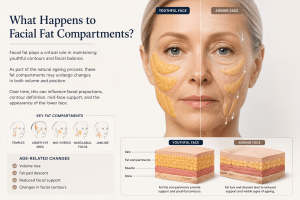
The face contains multiple fat compartments that help support:
- The cheeks
- Temples
- Under-eye area
- Jawline
- Lower face
As part of the natural ageing process, these compartments may undergo changes in both volume and position.
Over time, this can influence:
- Facial proportions
- Contour definition
- Mid-face support
- Lower-face appearance
These deeper changes often contribute more to facial ageing than wrinkles alone.
Changes in Facial Ligaments
Facial ligaments act as support structures that help anchor soft tissues in place.
These ligaments play an important role in maintaining facial architecture and overall facial support.
As ageing progresses, support systems within the face may gradually become less effective.
This can contribute to:
- Tissue descent
- Softer facial contours
- Reduced definition
- Changes in facial shape
Although these changes occur gradually, they are an important component of structural ageing.
Muscle Activity and Facial Ageing
Facial muscles are responsible for expressions such as smiling, frowning, and squinting.
These muscles work continuously throughout life.
Repeated facial movement contributes to natural expression lines over time.
At the same time, ageing-related changes in surrounding tissues may influence how facial expressions are reflected on the skin’s surface.
This interaction between muscles and skin is another reason facial ageing is considered a complex and dynamic process.
The Hidden Role of the Facial Skeleton
One of the most significant discoveries in facial ageing research is the role of the facial skeleton.
Facial bones provide the foundation upon which all soft tissues rest.
Research suggests that subtle changes may occur in certain areas of the facial skeleton over time.
These changes can affect:
- Cheek support
- Chin projection
- Jawline appearance
- Eye area structure
As the skeletal framework evolves, the overlying tissues may also change position and appearance.
This contributes to the overall ageing process and influences facial contours.
Why Facial Definition Changes Over Time
Many individuals notice a gradual loss of facial definition as they age.
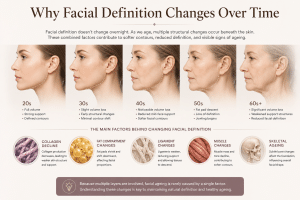
Common observations include:
- Less prominent cheeks
- Softer jawlines
- Lower-face heaviness
- Reduced facial contours
These changes are often the result of multiple factors occurring simultaneously, including:
- Collagen decline
- Tissue support changes
- Fat compartment alterations
- Ligament changes
- Skeletal ageing
Because several anatomical layers are involved, facial ageing is rarely caused by a single factor.
Structural Ageing and Modern Facial Assessment
The understanding of facial ageing has changed significantly over the past decade.
Rather than focusing solely on wrinkles and surface concerns, practitioners now evaluate the face as a complete structural system.
Modern facial assessment often considers:
- Skin quality
- Facial support
- Structural balance
- Tissue integrity
- Overall facial harmony
This broader perspective allows for a more comprehensive understanding of how ageing affects the face.
Healthy Ageing and Facial Structure
Healthy ageing has become an important focus within aesthetic medicine.
Many people are now interested in maintaining:
- Skin quality
- Facial support
- Natural contours
- Structural balance
- Overall facial harmony
This approach reflects growing awareness that ageing begins beneath the skin long before visible changes appear.
Understanding these deeper processes helps support informed decision-making regarding long-term skin and facial health.
What Happens Beneath the Skin During Facial Ageing?
Facial ageing is far more complex than the appearance of wrinkles or loose skin. Beneath the surface, gradual changes occur within collagen networks, fat compartments, facial ligaments, muscles, and the underlying facial skeleton. Together, these structural changes contribute to the evolution of facial contours, support, and overall appearance over time.
Modern aesthetic medicine increasingly recognises that successful facial assessment begins with understanding the deeper foundations of facial ageing. By appreciating what happens beneath the skin, patients can gain a clearer understanding of how facial ageing develops and why healthy ageing strategies often focus on maintaining both skin quality and structural support.
At Sky Beauty Cosmetic Clinic Sydney CBD (World Square) and Macquarie Park, our experienced medical team provides personalised consultations to assess facial ageing concerns and discuss treatment options tailored to individual facial anatomy, skin quality, and long-term aesthetic goals.