

The Science Behind Collagen and Healthy Skin
Collagen has become one of the most frequently discussed topics in aesthetic medicine. As scientific understanding of facial ageing continues to advance, increasing attention has shifted towards the role collagen plays in maintaining skin quality, facial support, and overall facial structure.
In recent years, collagen stimulation has emerged as a significant area of interest within modern healthy ageing research. Rather than focusing solely on visible signs of ageing, collagen-focused approaches aim to support the underlying structures that contribute to healthy skin and facial balance.
Understanding the science behind collagen stimulation can help explain why collagen has become such an important consideration in discussions about healthy ageing and aesthetic medicine.
What Is Collagen?
Collagen is the most abundant protein in the human body.
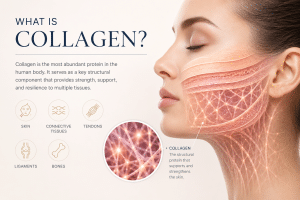
It serves as a key structural component within:
- Skin
- Connective tissues
- Tendons
- Ligaments
- Bones
Within the face, collagen helps provide:
- Structural support
- Skin firmness
- Tissue resilience
- Elasticity
- Facial integrity
Collagen acts as part of the framework that helps maintain the skin’s strength and overall appearance.
Because of its important structural role, collagen is often central to discussions surrounding facial ageing and skin quality.
Why Collagen Is Important for the Face
The face relies on multiple layers of support to maintain youthful contours and balanced proportions.
Collagen contributes to:
- Skin thickness
- Tissue support
- Facial structure
- Surface smoothness
- Overall skin quality
Healthy collagen networks help support the skin and underlying tissues.
As collagen levels naturally change over time, visible changes may occur throughout the face.
This is one reason collagen continues to be widely studied in skin biology and healthy ageing research.
What Happens to Collagen as We Age?
Collagen production is a natural biological process that occurs throughout life.
However, collagen synthesis gradually slows with age.
Beginning in early adulthood, the body’s ability to produce new collagen progressively decreases.
At the same time, existing collagen fibres become exposed to ongoing environmental and biological influences.
Factors that may contribute to collagen decline include:
- Natural ageing
- Sun exposure
- Smoking
- Environmental stressors
- Lifestyle factors
Over time, these changes may affect skin quality and facial support.
Understanding Collagen Remodelling
Collagen is not a static structure.
The body continuously breaks down and rebuilds collagen through a process known as collagen remodelling.
This process helps maintain tissue integrity and support normal skin function.
In younger individuals, collagen production and collagen breakdown remain relatively balanced.
As ageing progresses, this balance gradually changes.
When collagen synthesis slows, the overall support provided by collagen networks may decrease.
Understanding collagen remodelling is an important part of understanding facial ageing.
The Role of Fibroblasts
Fibroblasts are specialised cells found within connective tissues.
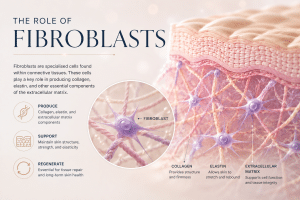
These cells play a key role in producing:
- Collagen
- Elastin
- Extracellular matrix components
Fibroblasts are essential for maintaining healthy skin structure.
When collagen stimulation is discussed in aesthetic medicine, fibroblast activity is often an important part of the conversation.
Scientific research continues to explore how collagen production and fibroblast function contribute to skin health and tissue maintenance over time.
What Is Collagen Stimulation?
Collagen stimulation refers to processes that encourage the body’s natural collagen production mechanisms.
Within aesthetic medicine, collagen stimulation is often discussed in relation to supporting:
- Skin quality
- Tissue integrity
- Facial support
- Healthy ageing
The concept is based on the understanding that collagen plays a fundamental role in maintaining facial structure.
As scientific knowledge continues to evolve, collagen stimulation has become an important topic within discussions surrounding facial rejuvenation.
Why Collagen Has Become a Focus in Modern Aesthetic Medicine
Historically, many aesthetic treatments focused primarily on addressing visible signs of ageing.
Today, there is increasing interest in understanding the biological processes that contribute to ageing itself.
This shift has led to greater emphasis on:
- Skin quality
- Tissue health
- Facial support
- Structural ageing
- Long-term maintenance
Because collagen influences many aspects of facial anatomy, it has become a central focus within this modern approach.
The growing popularity of regenerative aesthetics has further increased interest in collagen-related research and education.
Collagen and Structural Ageing
Modern facial ageing research recognises that ageing occurs throughout multiple anatomical layers.
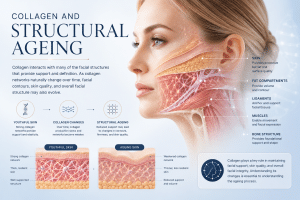
These layers include:
- Skin
- Fat compartments
- Ligaments
- Muscles
- Bone structure
Collagen interacts with many of these structures and contributes to overall facial support.
As collagen networks change over time, facial contours and tissue quality may also evolve.
This understanding has helped shift aesthetic medicine towards a more comprehensive view of ageing.
Healthy Ageing and Collagen Support
The concept of healthy ageing continues to gain popularity among patients and practitioners alike.
Rather than focusing exclusively on correction, many individuals are interested in supporting long-term skin and facial health.
Healthy ageing strategies commonly include:
- Sun protection
- Balanced nutrition
- Regular exercise
- Quality sleep
- Skin care
- Collagen-focused discussions
This broader perspective reflects growing awareness that skin health and facial ageing are influenced by multiple interconnected factors.
The Future of Collagen Research
Collagen remains one of the most actively researched topics within aesthetic medicine.
Ongoing studies continue to explore:
- Skin biology
- Tissue regeneration
- Fibroblast activity
- Extracellular matrix health
- Facial ageing processes
As scientific understanding advances, collagen is likely to remain a central component of discussions surrounding facial rejuvenation and healthy ageing.
The increasing focus on regenerative aesthetics suggests that collagen-related research will continue to shape the future direction of aesthetic medicine.
The Science Behind Collagen and Healthy Skin
Collagen is a fundamental component of healthy skin and facial structure. Its role extends far beyond surface appearance, contributing to tissue support, skin quality, and overall facial integrity. As collagen production naturally changes over time, understanding the science behind collagen stimulation has become increasingly important within modern aesthetic medicine.
By exploring the biological processes that influence collagen production and tissue maintenance, practitioners and patients can gain a deeper appreciation of how facial ageing occurs and why collagen remains such an important focus in discussions about healthy ageing and facial rejuvenation.
At Sky Beauty Cosmetic Clinic Sydney CBD (World Square) and Macquarie Park, our medical team provides personalised clinical assessments to better understand individual skin health and facial anatomy.