

Understanding Structural Ageing of the Face
Facial ageing is often associated with wrinkles, fine lines, and changes in skin texture. While these visible signs are commonly discussed, modern aesthetic medicine recognises that ageing involves much more than the surface of the skin.
In recent years, there has been increasing attention on the concept of structural ageing. Rather than focusing solely on wrinkles, structural ageing refers to the gradual changes that occur within the deeper layers of the face, including facial support systems, soft tissues, collagen networks, and underlying anatomy.
Understanding structural ageing can help explain why facial contours change over time and why modern facial rejuvenation approaches increasingly focus on supporting facial structure and maintaining overall facial harmony.
What Is Structural Ageing?
Structural ageing describes the gradual changes that occur beneath the skin as part of the natural ageing process.
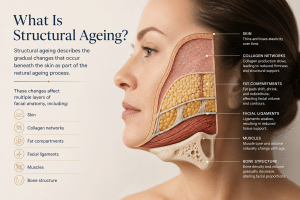
These changes affect multiple layers of facial anatomy, including:
- Skin
- Collagen networks
- Fat compartments
- Facial ligaments
- Muscles
- Bone structure
Because these structures work together to support the face, changes in one area often influence the appearance of others.
As a result, facial ageing is now understood as a complex structural process rather than simply a skin-related concern.
Why Facial Ageing Is More Than Wrinkles
Wrinkles are often the most visible sign of ageing, but they represent only one aspect of facial change.
Many individuals notice age-related changes such as:
- Softer facial contours
- Reduced cheek definition
- Changes in jawline appearance
- Lower-face heaviness
- Less facial support
These concerns frequently arise before significant wrinkles develop.
In many cases, the underlying cause is related to structural ageing rather than the skin alone.
This understanding has transformed how practitioners assess facial ageing and discuss treatment options with patients.
The Role of Collagen in Facial Structure
Collagen is one of the body’s most important structural proteins.
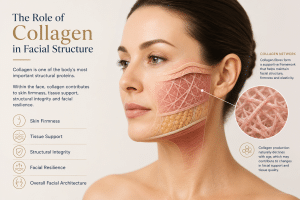
Within the face, collagen contributes to:
- Skin firmness
- Tissue support
- Structural integrity
- Facial resilience
- Overall facial architecture
Collagen production naturally declines with age.
Over time, this gradual reduction may contribute to changes in facial support and tissue quality.
Because collagen plays such a central role in facial structure, it has become an important focus in modern discussions about healthy ageing and facial rejuvenation.
How Facial Fat Compartments Change Over Time
The face contains multiple fat compartments that contribute to youthful facial contours.
These compartments help support:
- Cheek projection
- Facial proportions
- Mid-face volume
- Overall facial balance
As part of the natural ageing process, changes may occur in the distribution and support of these tissues.
These changes can influence:
- Facial shape
- Contour definition
- Lower-face appearance
- Overall facial harmony
Modern facial ageing assessments often consider how these deeper structures contribute to visible changes over time.
Understanding Facial Ligaments
Facial ligaments play an important role in maintaining facial support.
These structures help anchor tissues and contribute to facial stability.
Over the years, natural ageing processes may affect the strength and function of facial support systems.
As support changes, tissues may gradually shift, contributing to changes in facial contours and overall appearance.
Although these changes are not always visible initially, they form an important part of structural ageing.
Bone Structure and Facial Ageing
One of the lesser-known aspects of facial ageing involves the underlying facial skeleton.
Facial bones provide the framework that supports all overlying tissues.
Research has shown that subtle changes in facial bone structure can occur over time.
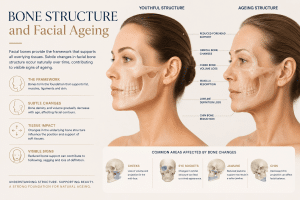
Areas commonly discussed include:
- Cheeks
- Eye sockets
- Jawline
- Chin
As the underlying framework evolves with age, the soft tissues above may also change in appearance.
This is one reason why facial ageing is increasingly viewed as a multi-layered process.
Why Facial Definition Changes With Age
Many people notice that their facial features appear less defined over time.
Common concerns include:
- Softer jawlines
- Reduced cheek prominence
- Changes in side profile appearance
- Less distinction between the face and neck
These changes are often influenced by a combination of factors, including:
- Collagen decline
- Structural support changes
- Tissue redistribution
- Skin quality changes
- Natural ageing processes
Understanding these factors helps explain why facial definition may gradually change throughout life.
The Importance of Facial Support
Facial support refers to the structures that help maintain facial shape and balance.
Healthy facial support contributes to:
- Defined contours
- Facial harmony
- Balanced proportions
- Structural stability
As support systems change over time, facial ageing becomes more apparent.
This is why modern facial assessment increasingly focuses on understanding the entire facial structure rather than individual features alone.
Structural Ageing and Healthy Ageing
Healthy ageing is becoming a major focus within aesthetic medicine.
Rather than attempting to alter appearance dramatically, many individuals seek strategies that support:
- Skin quality
- Facial structure
- Natural facial balance
- Long-term facial health
Understanding structural ageing allows patients to take a more informed approach to facial ageing and facial rejuvenation.
It also encourages a broader perspective that considers the face as a connected system rather than a collection of separate features.
Why Structural Ageing Matters in Modern Aesthetic Medicine
Advances in facial anatomy research have changed how practitioners evaluate ageing concerns.
Today, facial rejuvenation discussions often focus on:
- Structural support
- Facial harmony
- Skin quality
- Collagen health
- Long-term ageing management
This shift reflects a growing understanding that ageing affects multiple layers of the face simultaneously.
As a result, structural ageing has become one of the most important concepts in modern aesthetic medicine.
Understanding Structural Ageing of the Face
Structural ageing is a natural process that affects the deeper foundations of the face, including collagen networks, facial support structures, soft tissues, and underlying anatomy. While wrinkles remain a visible sign of ageing, many age-related changes originate beneath the skin long before they become noticeable on the surface.
By understanding structural ageing, patients can better appreciate how facial contours, support, and balance evolve over time. This modern perspective continues to shape contemporary approaches to facial assessment, healthy ageing, and facial rejuvenation.
At Sky Beauty Cosmetic Clinic Sydney CBD (World Square) and Macquarie Park, our experienced medical team provides personalised consultations to assess facial ageing concerns and discuss treatment options tailored to individual facial anatomy, skin quality, and long-term aesthetic goals.